***This page is available in English here*** 

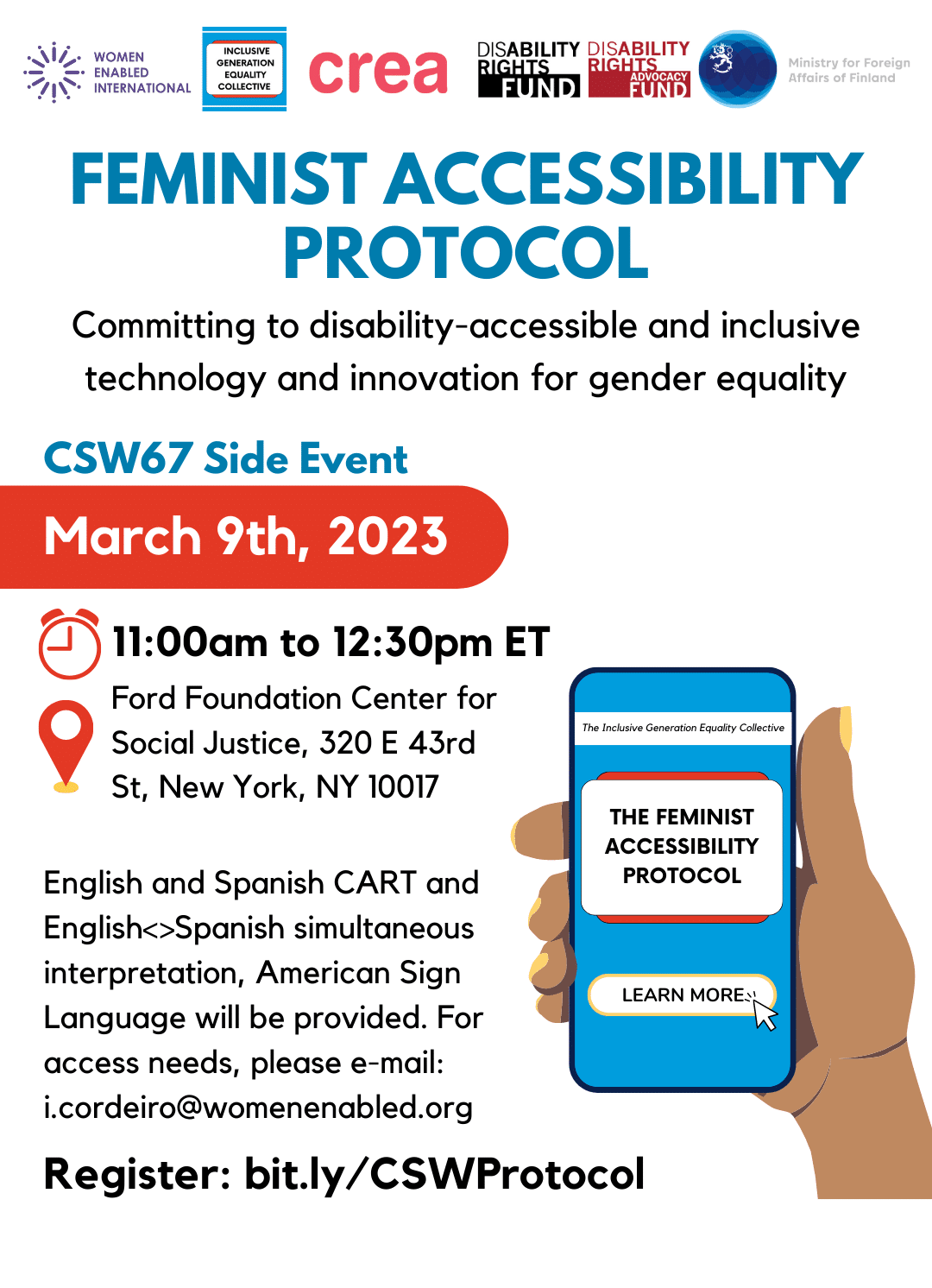
El Colectivo Inclusivo Generación Igualdad se enorgullece en presentar el Protocolo Feminista de Accesibilidad, un conjunto de compromisos innovadores que buscan garantizar la inclusión significativa de feministas con discapacidad en los espacios de igualdad de género. Obtén más información sobre el Protocolo y fírmalo a continuación.

Las mujeres con discapacidad representamos casi una de cada cinco mujeres en todo el mundo. En este contexto, somos partes esenciales del movimiento hacia la igualdad de género. Con demasiada frecuencia, sin embargo, las mujeres, las niñas, las personas trans, intersexuales y no binarias con discapacidad somos excluidas de los espacios clave en los que se toman decisiones importantes sobre la igualdad de género y los derechos relacionados con el género. Una y otra vez, las mujeres, las niñas, las personas trans, intersexuales y no binarias con discapacidad hemos observado que estos espacios no tienen en cuenta nuestros requisitos de accesibilidad y no reconocen las perspectivas importantes que traemos a estos debates.

El año pasado, volvimos a experimentar esta exclusión en un espacio clave para la igualdad de género a nivel mundial: los Foros Generación Igualdad, en los que muchas personas feministas con discapacidad ni siquiera pudieron acceder a las discusiones esenciales, y mucho menos contribuir sustancialmente a los importantes resultados del Foro. Tras esta experiencia, el Colectivo Inclusivo Generación Igualdad, un grupo de feministas con discapacidad, personas aliadas y organizaciones que abogan por los derechos y la justicia de género y discapacidad, decidió que ya era suficiente. Ya no nos conformaríamos con espacios de igualdad de género que no fueran totalmente accesibles e incluyeran a feministas con discapacidad.

El Protocolo Feminista de Accesibilidad es un resultado directo de estas experiencias y frustraciones. El Protocolo pide a los Estados, las entidades feministas de la sociedad civil, agencias de las Naciones Unidas y otros actores feministas que se comprometan a garantizar que, en el futuro, las discusiones sobre igualdad de género y los espacios de toma de decisiones sean plenamente accesibles e inclusivos para las mujeres, las niñas, las personas trans, intersexuales y no binarias con discapacidad. Cada uno de los 13 compromisos del Protocolo es un llamado a la acción sobre un aspecto específico de la accesibilidad y la inclusión en eventos y reuniones feministas, entre ellos la planificación, la ejecución y el seguimiento de los eventos.

La accesibilidad es un derecho humano, no un complemento opcional. Al comprometerse con las medidas de accesibilidad e inclusión descritas en el Protocolo, los Estados, la sociedad civil feminista, las agencias de las Naciones Unidas y otros actores feministas nos ayudarán a avanzar hacia un mundo donde la lucha por la igualdad de género incluya plenamente a las mujeres, las niñas, las personas trans, intersexuales y no binarias en toda nuestra diversidad.

¿Contamos contigo?

Accede a un video sobre el Protocolo con interpretación al sistema de señas internacional aquí:

Obtén más información sobre el Protocolo en diversos formatos aquí.

Firma el Protocolo en el formulario a continuación.

Contamos contigo para construir, colectivamente, un movimiento feminista verdaderamente inclusivo.


We found a leader like us. Maryangel Garcia-Ramos Guadiana

Women Enabled International’s Board of Directors couldn’t be more excited to announce that Maryangel Garcia-Ramos Guadiana [LINK] has joined Women Enabled International as our next Executive Director.

“The Board is thrilled to welcome Maryangel to the WEI family. We are so excited about her knowledge, skills, and perspective—a unique combination that will ensure both stability and innovation as Maryangel leads WEI into its second decade.” – Catherine Hyde Townsend, WEI Board President

A passionate changemaker, Maryangel has dedicated her career to shifting the narrative and culture of inclusion. As WEI’s Executive Director, Maryangel brings more than 15 years of diverse and deep expertise as a human rights advocate, leader, visionary for inclusion, and all-around badass. Maryangel joins WEI after leading the Office of Diversity and Inclusion at the Center for the Recognition of Human Dignity at Tecnológico de Monterrey, where she has been instrumental in developing strategies to strengthen community representation and promote equality for historically discriminated groups in one of México’s largest private universities. 

As a strategic communicator and a wheelchair user with lived experience at the intersection of gender and disability herself, Maryangel recognizes just how vital it is to lift up the voices—and diversity of lived experiences—of women, girls, and gender minorities with disabilities. This commitment led Maryangel, a native of México, to found Mexicanas con Discapacidad, a national network of women with disabilities. Additionally, she was recently named the President of the Council for Persons with Disabilities for the State of Nuevo León, México, a five-year, voluntary post where she will play a lead role in advancing the development of a State Plan for Disability Inclusion.

“Women, girls, and non-binary people with disabilities need to keep on being part of the human rights and gender equality conversations and platforms, more than ever. I am humbled and ready to continue the powerful work WEI has done over the past 10 years to advance our rights. I look forward to this new powerful moment in the world where we push a new generation of disabled feminist leadership.” – Maryangel Garcia-Ramos Guadiana, WEI Executive Director

Maryangel took the reins of Women Enabled International on October 3, 2022, following a year of interim leadership by Suzannah Phillips, WEI’s Director of Strategy. WEI’s pioneering founder, Stephanie Ortoleva, retired from the organization on September 30, 2021.

We hope you will join us at our 10th Anniversary celebration on October 20th [LINK], where Maryangel will have a chance to introduce herself and share more about her vision as she leads WEI into our second decade. 

Click the link to read Maryangel’s bio. [LINK]

Please reach out to Brittany Evans, WEI’s Communications Manager, at b.evans@womenenabled.org with media requests.

2021 Annual Report

As we look back on 2021, we are truly proud of WEI’s many achievements that strengthened recognition of the rights of women and gender minorities with disabilities, fostered inclusive movement building, and bolstered capacity to better meet the needs of our community.Your steadfast support makes our work possible. We thank you and hope you will continue to advocate alongside us to champion equality and justice for all.Click to read our 2021 Annual Report and learn how Women Enabled International met the moment during a time of change and anticipation of new beginnings.
2021 Annual Report Cover
ID: Text reads, “2021 Annual Report” above a photo of seven diverse women and young people smiling and laughing as they form a line and hug. Below is the Women Enabled International logo.
purple banner with the Women Enabled International logo and yellow and white text reading,”WEI’s with Anniversary Celebration. You’re Invited. October 20 at 11am ET.”
ID: purple banner with the Women Enabled International logo and yellow and white text reading, “WEI’s with Anniversary Celebration. You’re Invited. October 20 at 11am ET.”

It’s Time to Celebrate!

You’re invited to WEI’s 10th Anniversary Virtual Celebration on October 20th at 11 am ET.

Please join us for a community celebration of WEI’s 10-year milestone! During the event, you will hear from leaders across our movement while we honor the legacy of our pioneering founder, Stephanie Ortoleva.

Together we’ve achieved remarkable progress over the past decade. You are an important part of our story and future. We hope you will join us in celebrating this occasion on October 20th!

Event Information:

When: October 20, 2022, at 11 am Eastern Time
Where: Join the celebration via Zoom.
Register for the virtual event here: www.bit.ly/CelebrateWEI

This is a community celebration! CART captioning and international sign-language interpretation will be available. If you require other accommodations to celebrate with us, please don’t hesitate to contact WEI’s event coordinator, Luci Prosapio, directly via email at l.prosapio@womenenabled.org.

By registering, you will receive our celebration playlist as a thanks for being our guest. All registrants will also be entered into a raffle for a disability justice book bundle. The winner must be present in Zoom to win, so register today at www.bit.ly/CelebrateWEI!

Please mark your calendar and join Women Enabled International, the Pacific Sub-Regional Office of the United Nations Population Fund, and the Pacific Disability Forum for the launch of three groundbreaking resources documenting the lived experiences of women and young people with disabilities around sexual and reproductive health and rights (SRHR), gender-based violence (GBV), and access to essential services in Fiji, Samoa, and Vanuatu

Launch Event: August 22 – 6 pm – 8 pm EST // August 23 – 10 am – 12 pm Fiji time 

Register here: www.bit.ly/PacificLaunch

These new resources center the voices of women and young people with disabilities in Fiji, Samoa, and Vanuatu and offer recommendations for States on how to take action and respond to guarantee essential rights.

Testimonies from our community in the Pacific Region:  

  • “A friend of mine with disabilities was raped on a bus while going home. Her family filed a report at the police station, but nothing has happened ever since.” Woman with a physical disability from Port Vila.(Vanuatu)  
  • “Sex and family planning are taboos in our culture. Therefore, persons with disabilities lack information and knowledge about these issues.” Woman with a visual impairment from Suva (Fiji) 
  • “When I was pregnant, I was so looking forward to taking care of my baby….., [but] my family told me I could not look after my baby.” Deaf woman from Apia (Samoa) 

During the event, speakers will also share what actions are already being taken to implement the report’s recommendations, including an exciting, innovative pilot project being implemented to expand demand for and access to sexual and reproductive health (SRH) services among women and young people with disabilities in Fiji.

Key report recommendation for States 

Recruit and train women and young people with disabilities to serve as Community Health Liaisons to provide peer-to-peer education and accompaniment to SRH and GBV services. This role can help strengthen understanding among women and young people with disabilities about the availability and appropriateness of SRH and GBV services, as well as dismantle perceptions that SRH and GBV services are not for people with disabilities.  

Join us to celebrate this groundbreaking research and learn more about how the reports live beyond their pages on August 22 – 8 pm – 8 pm EST // August 23 – 10 am – 12 pm Fiji time.

This event will be held over Zoom. CART captioning and Fijian and Samoan sign-language interpretation will be available. Please register in advance and request any access needs at: www.bit.ly/PacificLaunch or by emailing s.minieri@womenenabled.org.

The full reports are available at the following links:  


Check out related work and learn more about the project and our partners in the Pacific:


Event Flyer

Flyer text: “Women and Young People with Disabilities in Fiji, Samoa and Vanuatu: A Needs Assessment of Sexual and Reproductive Health and Rights, Gender-Based Violence, and Access to Essential Services.” Below there is the image of a small calendar and to the right text reads: Tuesday- August 23, 2022. 10:00 AM – 12:00 PM (Fiji time). Below, against a white background, text reads: “This event will be held over Zoom. CART captioning and Fijian and Samoan sign-language interpretation will be available. Please register in advance and request any access needs at: www.bit.ly/PacificLaunch or by emailing s.minieri@womenenabled.org.
Flyer description:
Within an orange frame, there is a text box. At the top, against a white background, text reads: Publication Launch Event. Below, against a purple background, title reads: “Women and Young People with Disabilities in Fiji, Samoa and Vanuatu: A Needs Assessment of Sexual and Reproductive Health and Rights, Gender-Based Violence, and Access to Essential Services.” Below there is the image of a small calendar and to the right text reads: Tuesday- August 23, 2022. 10:00 AM – 12:00 PM (Fiji time). Below, against a white background, text reads: “This event will be held over Zoom. CART captioning and Fijian and Samoan sign-language interpretation will be available. Please register in advance and request any access needs at: www.bit.ly/PacificLaunch or by emailing s.minieri@womenenabled.org.
Below, text reads “Sponsored by: UNFPA, Australian Aid, Pacific Disability Forum, and WEI. To the right are three digital illustrations: the first is an illustration of two people standing close to each other. One has a prosthetic arm, and the other has a flower in their hair and are using a black cane. The second is an illustration of two people standing close to each other and holding hands. They both have a prosthetic leg. One has short hair, and the other has long hair. The third is an illustration of two people. One has short hair and uses a wheelchair. They are raising their hands. The other has a flower in their hair and is holding the wheelchair to support the other moving around).


Women Enabled International is deeply distressed by the Supreme Court of the United States’ decision in Dobbs v. Jackson Women’s Health Organization today, which overturns a nearly 50-year legal precedent and eliminates a federal right to abortion in the United States.

As a result of this decision, abortion could become illegal or severely restricted in over half of U.S. states and territories, with devastating consequences for the lives and health of more than 40 million women and other people with the biological capacity to become pregnant.

The impact of this decision will be felt deeply across the United States and around the globe. WEI is committed to working in partnership with disability and reproductive rights and justice organizations across the country to mitigate the harmful effects of this decision on our community and to ensure that the voices and perspectives of women and gender minorities with disabilities are included in this important fight for our human rights.

In addition to WEI’s ongoing work to bring an intersectional gender and disability lens to discussions and advocacy around abortion rights, in the coming months we plan to:

· Give guidance to abortion funds about how to ensure that funding reaches and is inclusive of women and gender minorities with disabilities.

· Develop and disseminate accurate information about the impact of the Dobbs decision in accessible formats.

· Bring the learnings from our sisters in other countries who have participated in their countries’ movements for abortion rights to inform the longer-term response of U.S. disability rights and justice actors to this human rights crisis.

Today’s decision is a significant attack on our fundamental rights, and we share the pain, anger, and exhaustion that so many of you feel. But while this marks the end of an era in abortion rights in the United States, the fight does not end here—WEI remains committed to engaging in strategic and collective advocacy to reclaim our right to bodily autonomy.


  • Click here to read WEI’s full statement regarding the Supreme Court of the United States’ decision in Dobbs v. Jackson Women’s Health Organization.
  • Click here to read our joint statement with other leading disability organizations united in opposition to this ruling.
  • Click here to read WEI’s groundbreaking publication outlining an international legal framework for abortion at the intersection of gender and disability: Abortion and Disability: Towards an Intersectional and Human Rights-Based Approach.
  • Join our mailing list and be the first to know about upcoming events, new publications, and ways you can get involved with WEI.

Newsletter header: Photo of a group laughing. To the right is the Women Enabled International logo.

Dear Disabled Women’s Rights Supporter,

Women Enabled International is the sole international human rights advocacy organization focusing exclusively at the intersection of gender and disability, but ours is not a solo mission.  Everything we do is in collaboration with feminists with disabilities at the regional and national levels.

This edition of WEI e-news offers examples of how we leverage these powerful partnerships to facilitate network building, amplify voices, and bring our distinct expertise to bear to ensure that human rights standards and commitments respond to lived experiences of women, girls and gender minorities with disabilities around the world.

While we celebrate the advances that we are making every day – and commemorate our cumulative progress during this 10th anniversary year, we must also acknowledge the ongoing and imminent threats to our community’s safety and security. Women and gender minorities with disabilities are disproportionately impacted in times of crisis and conflict. I urge you to read WEI’s statement about Ukraine and accompanying resources. We stand in solidarity with WEI partners in Europe who are responding to the crisis there.

With gratitude,

Signature


Suzannah Phillips
Interim Executive Director

Click here to read the full newsletter.

Statement of Solidarity with Women, Girls, and Gender Minorities with Disabilities in Ukraine

Thursday 24 February 2022

Women Enabled International (WEI) extends our solidarity to the people of Ukraine in the face of the conflict that is rapidly developing in the face of Russian aggression. WEI expresses particular concern for the situation for women, girls, and gender minorities with disabilities in Ukraine, who will be particularly at risk of human rights violations during the conflict.

There are at least 2.7 million persons with disabilities in Ukraine, approximately half of whom are women and girls. War and conflict have a disproportionate impact on the rights and well-being of women, girls, and gender minorities with disabilities.

  • They face heightened risks of sexual and gender-based violence in conflict, due to a range of factors. For instance, they may lose access to assistive devices, support people, and other protective networks. They may also lack accessible information that would facilitate their escape from conflict, placing them at greater risk of violence by soldiers and others.
  • If they are able to escape, the conflict will restrict access to food, shelter, and other basic necessities – a harm that is exacerbated for women, girls, and gender minorities with disabilities who are already more likely to experience poverty outside of conflict.
  • Inaccessible relief facilities and humanitarian assistance can increase reliance on others to meet basic needs, further exposing them to higher risk of violence and exploitation.
  • They also may lose access to needed sexual and reproductive health services, vital particularly for pregnant persons and those subjected to sexual and gender-based violence, and to important sexual and reproductive health goods, such as sanitary pads or contraception.

States have a particular obligation to ensure rights for and protection of women, girls, and gender minorities with disabilities during armed conflict. This includes, according to the Special Rapporteur on the Rights of Persons with Disabilities, “developing specific protections for [them] during the conduct of hostilities at the strategic, tactical and operational levels,” and, as the U.N. Security Council has found, ensuring sustainable, timely, appropriate, inclusive and accessible humanitarian assistance. It further includes an obligation to ensure that they are free from violence, have access to sexual and reproductive healthcare services, and have redress for any human rights violations committed against them.

With these obligations in mind, we call on actors in Ukraine to:

  • Ensure that women, girls, and gender minorities with disabilities have access to sexual and reproductive goods, such as sanitary pads and contraceptive pills, and essential sexual and reproductive health care, such as maternal healthcare and GBV services.
  • Prevent and redress sexual and gender-based violence against women, girls, and gender minorities with disabilities, including by evacuating and ensuring that they can flee conflict-affected areas, ensuring that humanitarian assistance is directly accessible to them and is disability- and gender-responsive, and ensuring accessible justice mechanisms for violence during the conflict.
  • Ensure that women, girls, and gender minorities with disabilities have access to information about humanitarian assistance and about response to GBV and SRH during the conflict, provided in accessible formats such as sign language, braille, Easy Read and plain language.
  • Ensure that women, girls, and gender minorities with disabilities are provided direct access to food, water, medical supplies, healthcare, evacuation assistance, accessible transportation, safe and accessible shelters, and other measures to reduce the impact of the conflict on their lives.

Further Resources on Gender, Disability, and Armed Conflict:

Statements from Colleague Organizations:

Women Enabled International joins eight other leading international human rights organizations in filing an amicus brief before the European Court of Human Rights on Poland’s restrictive abortion law. 
Restrictive abortion laws such as Poland’s are contrary to international and European human rights standards and public health guidelines. They compromise women’s freedom, dignity, health, and livesOur organizations’ interventions seek to highlight critical human rights aspects of such restrictive laws, and we are proud to support efforts to hold Poland accountable for these ongoing human rights violations, the organizations said.”
Filing organizations:
  • Amnesty International 
  • Center for Reproductive Rights
  • Human Rights Watch
  • International Commission of Jurists
  • International Commission of Jurists
  • International Federation for Human Rights
  • International Planned Parenthood Federation European Network
  • Women Enabled International
  • Women’s Link Worldwide
  • World Organisation Against Torture

Cover of Women Enabled International 2020 Annual Report featuring a close-up image of a person wearing a brightly decorated surgical face mask gazing up and into the distance.

In a year marked by crisis and assault on human rights, particularly for women and other gender minorities with disabilities, Women Enabled International and our partners around the world drew on our collective strength and expanded the limits of our resiliency.

We equipped feminists with disabilities to use their power to claim their rights, compelled governments to acknowledge and address discrimination, expanded the evidence-base for intersectional gender- and disability-inclusive responses to urgent humanitarian needs, and provided training and resources necessary to make laws, systems, and services more inclusive, accessible and just.

Your steadfast support makes our work possible. We thank you and hope you will continue to advocate alongside us to champion equality and justice for all.

Click to read our 2020 Annual Report and learn how Women Enabled International met the moment during a pivotal year of global transformation.