Leadership Message

We are excited to share Women Enabled International’s 2022 Annual Report. This was a year of momentous celebration, marking our 10th anniversary and bright beginnings to help forge WEI’s future.

2022 WEI Annual Report Cover WEI is the only global organization focused exclusively on the human rights of women, girls, and gender-diverse people with disabilities. In the face of rising gender-based violence and anti-rights movements worldwide, we remain steadfast in our commitment to increasing the visibility of our multiply marginalized community and seeing our rights recognized and realized.

Throughout the year and at a special event in October 2022, we looked back at WEI’s impact in our first decade and paid tribute to the people who have worked to advance our mission and our movement – especially our staff and women with disabilities around the world. Click here to access a brief anniversary video featuring esteemed global advocates, allies, and champions of human rights at the intersection of gender and disability.

Every year, as WEI grows, so does our reach and impact. In 2022, WEI widened our networks, deepened our partnerships, and substantially increased our staff and budget through diversified funding sources. To sustain this growth and strengthen organizational resilience, WEI secured a coveted BUILD grant from the Ford Foundation to further invest in the people, finances, systems, and strategies needed to thrive into the future.

Thus, WEI ended 2022 perfectly positioned to develop our next 5-year strategic plan. WEI has established an incredibly strong foundation, with touchstone values that will guide our work going forward – intersectional feminism, disability justice, community, accountability, respect, and dignity.

We feel energized – and privileged – by the opportunity to shape what’s next for this unique and vital organization, understanding the great responsibility we bear as we pursue equality and justice for women, girls, and gender-diverse people with disabilities worldwide.

In gratitude and solidarity,

Maryangel García-Ramos Executive Director

Catherine Townsend President, Board of Directors


Read about our extensive programmatic impact in our 2022 Annual Report.


MENSAJE DE LA DIRECCIÓN EJECUTIVA Y LA JUNTA DIRECTIVA

Nos complace compartir el Informe Anual 2022 de Women Enabled International. Esteaño estuvo marcado por celebraciones trascendentales, como nuestro décimoaniversario y el inicio de una etapa brillante, en la que dimos la bienvenida a una nuevaDirectora Ejecutiva para ayudar a forjar el futuro de WEI.

Informe Anual 2022 WEI es la única organización internacional que trabaja de forma exclusiva en losderechos humanos de las mujeres, las niñas y las personas de género diverso condiscapacidad. Frente al aumento de la violencia de género y los movimientosantiderechos alrededor del mundo, nos mantenemos firmes en nuestro compromiso poraumentar la visibilidad de nuestra comunidad y garantizar el reconocimiento, laprotección y el ejercicio de nuestros derechos.

A lo largo del año y en un evento especial en octubre de 2022, reflexionamos acercadel impacto de WEI en nuestra primera década y rendimos tributo a todas aquellaspersonas que han trabajado con incansable dedicación en pos del progreso de nuestramisión y nuestro movimiento, sobre todo nuestro personal y las mujeres condiscapacidad de todo el mundo. Haga clic aquí para ver un breve vídeo de nuestroaniversario, en el que figuran grandes activistas por los derechos humanos en laintersección del género y la discapacidad y otras personas aliadas.

Con cada año que pasa, WEI ha crecido. conn ello también nuestro alcance e impacto. En 2022, WEI amplió sus redes, fortaleció sus alianzas e incrementó de maneraconsiderable su personal y presupuesto a través de fuentes de financiacióndiversificadas. Con el fin de mantener este crecimiento y consolidar una resilienciaorganizacional, WEI obtuvo la codiciada subvención BUILD de la Ford Foundation parainvertir más en la gente, las finanzas, los sistemas y las estrategias que se necesitanpara prosperar en el futuro.

WEI terminó el 2022 muy bien posicionada para su elaborar siguiente plan estratégicode 5 años. La organización sentó cimientos sólidos sobre los que continuar su labor, ydefinió los valores fundamentales que guiarán su trabajo de ahora en adelante, entreellos feminismo interseccional, justicia para la discapacidad, comunidad, rendición decuentas, respeto, y dignidad.

Nos sentimos honradas y revitalizadas por el privilegio que significa la oportunidad deconstruir el futuro de esta organización única y vital, y comprendemos la granresponsabilidad que tenemos en la búsqueda de la equidad y la justicia para lasmujeres, las niñas y las personas de género diverso con discapacidad alrededor delmundo.

En gratitud y solidaridad,

Maryangel García-Ramos Directora Ejecutiva

Catherine Townsend Presidenta de la Junta Directiva


Lea acerca de nuestro extenso impacto programático en nuestro Informe Anual 2022.

Transforming Feminist Spaces for Accessibility: From Commitment to Reality 

Join us on September 19th, 2 pm ET, for an exciting event that bridges the gap between commitment and practice in creating accessible feminist spaces. The event is co-hosted by the Inclusive Generation Equality Collective and Women Enabled International, and brings on board actors from across the disability rights and feminist movements. We’ll explore the Feminist Accessibility Protocol and how Women Deliver turned their commitments to disability inclusion into reality, offering lessons for other feminists. The event will feature diverse voices from the feminist and disability rights sectors. 💜🌟

Registration: bit.ly/GEFMidpointEvent


Transformando Espacios Feministas para la Accesibilidad y la Inclusión: del Compromiso a la Realidad.

Únete a nosotras el 19 de septiembre a las 2pm ET, a un evento emocionante que cierra la brecha entre el compromiso y la práctica en la creación de espacios feministas accesibles. El evento está organizado conjuntamente por el Colectivo Inclusivo Generación Igualdad Inclusiva y Women Enabled International, y reúne a actores de todos los movimientos feministas y por los derechos de las personas con discapacidad. Exploraremos el Protocolo de Accesibilidad Feminista Women Deliver convirtió en realidad sus compromisos con la inclusión de la discapacidad, ofreciendo lecciones para otras feministas. El evento contará con diversas voces de los sectores feminista y de derechos de las personas con discapacidad. 💜🌟

Registro en: bit.ly/GEFMidpointEvent

Dear community,

I reach out because, after seven months leading Women Enabled International, I want to share with you my deep concerns about the challenges women, girls and gender-diverse people with disabilities experience in the world we live in now.

Humanitarian crises—conflict, climate change, rising authoritarianism, and public health emergencies—are proliferating around the globe. These crises disproportionately threaten the human rights of women, girls, and gender-diverse people with disabilities.

Women Enabled International (WEI) is accelerating our advocacy to address these threats and ensure the safety, security, and dignity of people living at the intersection of gender and disability.

You can play a vital role in addressing these challenges with us.

Please donate today to safeguard the human rights of all people in crisis situations.

Click Here to Donate 

Together with our partners, WEI documents the dire consequences of conflict and humanitarian emergencies for our community worldwide, for example:

Climate Change: Many indigenous women and girls with disabilities in Nepal cannot access fresh food and are compelled to walk for hours to fetch water, negatively impacting their health and menstrual hygiene.

Violent Conflict: In Ukraine, people with disabilities are being abandoned instead of evacuated from war zones because aid groups lack the capacity to facilitate accessible transport and services.

Natural Disasters: In Puerto Rico, where 22% of women are women with disabilities, the U.S. government’s delayed response to Hurricane Maria left thousands without power, which had devastating consequences for people who rely on electricity for breathing or mobility.

COVID-19: Women, girls and gender-diverse people with disabilities worldwide experienced increased sexual and gender-based violence and barriers to accessing related support services, police, and justice mechanisms during pandemic lockdowns. Even now with those orders lifted, the coronavirus still threatens those at greater risk for serious illness and complications.
In crisis situations, governments have an obligation to take action to protect the rights of women, girls, and gender-diverse people with disabilities, particularly those who experience discrimination and marginalization on the basis of multiple and intersecting identities (race, ethnicity, caste, etc.)

WEI plays a critical role by amplifying the voices of the most impacted, partnering to connect local advocates and global decision-makers, and holding international agencies and states accountable for implementing inclusive and appropriate policies and protections.

Your contribution will support WEI’s development and dissemination of tools, trainings, and resources to equip those in humanitarian emergencies to assert their rights. You can support WEI and our partners’ powerful advocacy targeting laws, systems, and services towards more inclusive, accessible, and just responses.

Please join us by making a personal financial contribution – of any amount – to keep the focus on rights at risk in humanitarian crises.

Your support holds power accountable to ensure crisis preparedness, response, and recovery efforts are gender and disability inclusive.

Donate Today

I am incredibly proud of the work WEI is doing – which has never felt more urgent. I hope we can count on your support.

Gracias,

Maryangel

Maryangel GRG Headshot

Catch WEI at CoSP 16

Women Enabled International (WEI) is heading to New York for the 16th Session of the Conference of States Parties to the Convention on the Rights of Persons with Disabilities (CoSP 16)! We’d love for you to join us, whether in person or in spirit, as we bring critical perspectives, experience, and expertise on the intersection of gender and disability to ensure that the discussions, decisions, and outcomes at CoSP are not just inclusive but also empowering and effective in their impact on individuals and communities worldwide.

CoSP is a significant global event that shines a light on the rights of all persons with disabilities, making it an essential platform to highlight and address the unique challenges faced by women and gender-diverse persons with disabilities. Our presence and participation at CoSP not only advances this critical dialogue but ensures the experiences and leadership of women and gender-diverse people with disabilities are essential to decision-making processes and our solutions are incorporated into global policy-making and advocacy.

We’re thrilled to host and participate in three dynamic events:

Equal Rights and Choices for Women and Young Persons with Disabilities: Innovative Interventions to Ensure Access to Sexual and Reproductive Health and Rights

When: 13th June, 3:45 pm – 5:00 pm
Where: UNFPA Headquarters, Orange Café or via Zoom
What: We’ll delve into the multifaceted issues around ensuring the realization of sexual and reproductive health rights (SRHR) for persons with disabilities, with a particular focus on women and youth.

Registration is required for this event: bit.ly/CoSP16SideEvent 

Strengthening Gender Inclusion in Disability Rights Spaces

When: 14th June, 2:30 pm – 4:00 pm
Where: United Nations Church Center, Second Floor Conference Room
What: Join our dynamic panel discussion on how to promote gender inclusion in mainstream disability rights spaces, complete with a launch of our resource guide. Remember to bring your face mask, as they will be required for this event!

No registration is required for attendees. 

Stronger Together: Gender and Disability Intersectional Movements at the Forefront of Human Rights Advocacy

When: 14th June, 4:45 pm
Where: The United Nations, Conference Room C
What: Explore the growing movement championing the rights of women, girls, and gender-diverse persons with disabilities and discover new tools and tactics to amplify our impact.

Cohost: CRPD Committee

Co-sponsors: Canada, UN Permanent Mission of Panama, OHCHR, UN Women, Generation Equality Action Coalition on Feminist Movements and Leadership, Sightsavers, International Disability Alliance, United Cities and Local Governments, and Women Gaining Ground.

This event is intended for registered CoSP attendees only.

WEI Co-Sponsored Events:

  • Ending forced sterilisation of persons with disabilities and promoting sexual and reproductive rights
    • When: Tuesday, 13th June, 9:45 to 11:00am EST
    • Where: Conference Room C, United Nations Headquarters in New York
    • Sponsors: UN ESCWA, Malta and European Disability Forum
    • Description: Forced and coerced sterilisation of people with disabilities is a human rights violation that has been and continues to be protected as a matter of law, policy and custom throughout the world. This side-event will provide a state of play on the issue and discuss commitment and future actions to make the end of forced sterilisation of persons with disabilities a reality. Alarming instances drawn from current policy and practice will also be tackled.
  • From Beijing to the CRPD and Beyond: How women with disabilities are shining a light on intersectional gender rights
    • When: Thursday, 15th June, 1:15 to 2:30pm EST
    • Where: Conference Room 11, United Nations Headquarters in New York
    • Hosted by: Permanent Mission of the United Kingdom of Great Britain and Northern Ireland to the United Nations together with the International Disability Alliance
    • Co-sponsored by: UN Women, Women Enabled International
    • Description: The session will draw from the experiences of women with disabilities from Beijing till today; on the successes and gaps in ensuring participation and leadership of women with disabilities in the human rights, development and humanitarian space. It will look at good practices and outline what more needs to be done to ensure an intersectional approach particularly as the world discusses acceleration of the Sustainable Development Goals (SDGs) through the SDGs Summit and prepares for ‘A Pact for the Future’. The session will aim to contribute to the ongoing work of the disability movement’s advocacy to ensure that interventions towards accelerating the SDGs and preparation to implement ‘Our Common Agenda’ does not leave women with disabilities behind.

Other Events Featuring the WEI Team:

Model Maternity Protocol for Women with Disabilities

When: Tuesday, 13th June, 4:45pm – 6:00pm EST
Where: Conference Room C, United Nations Headquarters in New York


Even if you’re not in New York, your support is still crucial. We’ll be sharing regular updates from these events through our social media, ensuring you stay connected to the latest dialogues and advances impacting the intersection of gender and disability rights.

New amicus curiae brief before the I/A Court H.R.

The Latin American Team of Justice and Gender (ELA) and Women Enabled International (WEI) submit an amicus curiae brief * on the case Beatriz vs. El Salvador before the Inter-American Court of Human Rights (I/A Court H.R.). The brief stresses that States have an obligation to ensure the right of women and other persons with and without disabilities to access legal, safe and quality abortion services, in particular when pregnancy poses a risk to their life and health, as was the case with Beatriz.

About the case

In 2013, Beatriz, a young woman from El Salvador, was diagnosed with a high-risk pregnancy with fetal anencephaly, which implied the extrauterine unviability of the fetus. Beatriz lived in extreme poverty and, at age 20, she had been diagnosed with systemic lupus erythematosus, lupus nephropathy, and rheumatoid arthritis. Despite the fact that Beatriz’s medical team requested the termination of the pregnancy to safeguard her life, the request was rejected by the authorities of the health center, which forced Beatriz to request the Constitutional Chamber of the Supreme Court of Justice to order them to carry out the termination of the pregnancy. More than 40 days later, the Constitutional Chamber rejected her request on the grounds that in El Salvador there is an absolute impediment to the authorization of interruptions of pregnancies, since the Constitution protects human life from conception. In line with this rule, the Criminal Code of El Salvador establishes that the voluntary termination of pregnancy is a crime in all situations.

Given the delay of the Constitutional Chamber in resolving the petition and the negative impact that this situation had on her health, Beatriz appealed to the Inter-American Commission on Human Rights (IACHR) and the I/A Court H.R. It was finally this court that ordered the Salvadoran State to take the necessary measures to protect Beatriz’s life, health and integrity. Given the advanced state of Beatrice’s pregnancy, a caesarean section was performed. The new born died five hours later.

In this context, in November 2013, several human rights organizations filed a lawsuit before the IACHR against the State of El Salvador, alleging its international responsibility for the human rights violations of Beatriz and her family. Beatriz’s case finally reached the I/A Court in January 2022.

About the amicus curiae brief

*An amicus curiae (“friend of the court”, in Latin) is a person or organization that has a strong interest in the issues brought up in a case to which they are not a party. The amicus curiae may submit a written report setting forth its interpretation of the law or its arguments relating to the facts under consideration by the Court.

You can learn more about amicus curiae briefs and how interact with the Inter-American human rights system here.

In their amicus curiae brief, ELA and WEI highlight that:

● Women and other persons with and without disabilities have the right to access legal, safe and quality abortion services, particularly when pregnancy poses a risk to their life and health.

● Beatriz’s case shows that the Salvadoran State is failing in its obligation to take the appropriate measures to guarantee access to legal, safe and quality abortion services for women and other persons with and without disabilities in the light of the regulations of the inter-American human rights system and human rights treaties of the United Nations;

● The absolute criminalization of abortion – such as that existing in El Salvador – harms the right of women and other persons with the capacity to become pregnant with and without disabilities, and constitutes a form of gender-based violence. In some circumstances it may also constitute torture or cruel, inhuman or degrading treatment;

● States, including El Salvador, should take effective measures to eliminate stigma and discrimination against persons with disabilities without affecting the fundamental human rights of women and other persons with the capacity to become pregnant and, in particular, without impeding their access to legal, safe and quality abortion services.

Click here to read the full report.

GAAD #CommitToAccess

Women Enabled International is proud to be a leader of the Generation Equality Action Coalition on Feminist Movements and Leadership, and in that role and beyond, to advocate for strong and sustainable feminist movements and participation and leadership at all levels worldwide. We celebrate the pivotal place that feminists with disabilities—who account for nearly 1 in 5 women globally—have held in shaping feminist movements and in creating a world where gender equality, disability justice, and human rights are fully realized.

We also recognize a critical gap in feminist movements and spaces: they are frequently inaccessible for people with disabilities. This gap is particularly apparent in the spaces where movements convene and where policymakers and others make decisions about how to advance gender equality and women’s rights.

“,,,without accessibility we cannot participate in private, social or political life. In events on gender equality, if there is no accessibility, we are left behind and discriminated against.” – Cristina Dueñas, a member of the Inclusive Generation Equality Collective from Spain

Today—on Global Accessibility Awareness Day—and moving forward, Women Enabled calls on all feminist actors to recognize that accessibility is a core feminist value and a prerequisite for inclusive, diverse feminist movements and leadership. Feminist actors can and should make accessibility a part of their routine, whether that means hosting events and meetings in physically accessible locations, providing sign language interpretation or closed captions, ensuring quiet spaces and breaks, or otherwise just asking what feminists with disabilities need to participate and be included.

Accessibility is a Feminist Issue
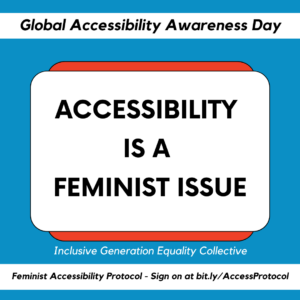
A blue background, at the top a white line holds black text reading, “Global Accessibility Awareness Day.” Below, a white box with red accents holds text, “Accessibility is a feminist issue.” “Inclusive Generation Equality” appears below in white. Another white line with black text reads, “Feminist Accessibility Protocol – Sign on at bit.ly/AccessProtocol.”

“As local and regional governments, we remain committed to promoting inclusion, accessibility and universal design, and to ensuring the active participation of all women and gender-diverse groups; as a feminist municipal movement, we are committed to putting care at the center” – Carolina Cosse, President of United Cities and Local Governments, Mayor of Montevideo

We further call on all feminist actors to #CommitToAccess and sign on to the Feminist Accessibility Protocol. In December 2022, a group of feminists with disabilities and allies called the Inclusive Generation Equality Collective launched the Feminist Accessibility Protocol [LINK] in an effort to uplift accessibility as a feminist value and provide guidance on how to ensure accessibility in feminist spaces. The Protocol calls on States, United Nations agencies, feminist civil society, and other feminist actors to uphold intersectional feminist values and ensure that gender equality and women’s rights spaces are fully accessible to and inclusive of feminists with disabilities in all of their diversity.

When gender equality and women’s rights spaces are accessible and inclusive, it transforms the ways in which feminists with disabilities can participate and contribute.

Space with sign language interpretation, with three/four sign languages, different methods of access, changes the whole quality and feeling of a space.” – participant in CREA’s Disability, Sexuality and Rights Online Institute “It helped me feel very represented and helped me feel that my voices are being centered. And it was so easy to learn because there were accessibility aids that were given to us.” – participant in CREA’s Disability, Sexuality and Rights Online Institute, explaining the impact of an accessible and inclusive feminist space 

Together, we can create a lasting impact by ensuring that accessibility remains at the core of our feminist values and underpins our work to build sustainable, diverse and inclusive feminist movements and leadership.

“The Feminist Accessibility Protocol is a tool for feminists with disabilities to achieve that effective inclusion in the feminist movement. Once and for all, with accessibility, gender equality can turn from a utopia into reality.” –  – Cristina Dueñas, a member of the Inclusive Generation Equality Collective from Spain

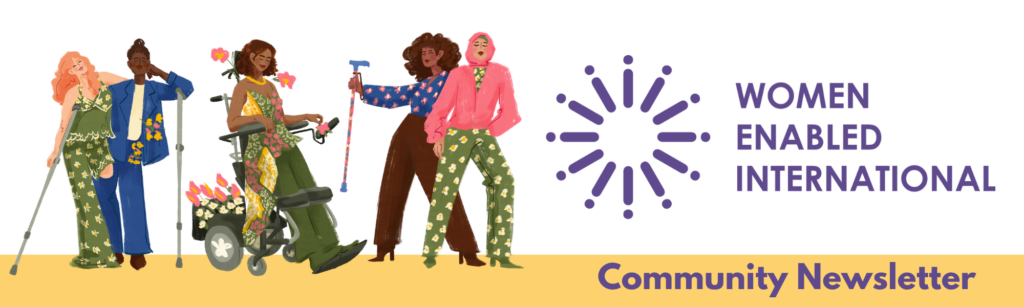
Community Newsletter Header with Illustrations of disabled people
Illustration of diverse disabled people dressed in fashionable floral clothes next to the WEI logo.

Dear Community,

My first six months as Executive Director of Women Enabled International have been incredible. I am so grateful to our global community for warmly welcoming me and being so generous in sharing your time and expertise to help me acclimate to my new role.

One thing I was happy to learn, as I shifted from advocating for gender and disability rights on a national and regional level to the international level, is that this movement exists in our disabled voices and truly feels like a community. Our greatest challenge is to bridge connections across diverse genders, disabilities, cultures, and contexts to keep pushing for disabled leadership–but given the opportunity, we always show up for each other.

These last few months, we’ve been able to be together in person again–jointly advocating with our partners before UN human rights experts in Geneva, sponsoring and speaking at events as part of the annual Commission on the Status of Women conference in New York, and convening the WEI Board for its first-ever in-person retreat. While COVID taught us not only how to keep our work going through virtual-only meeting spaces–and in many ways improved accessibility for feminists with disabilities around the world–these recent meetings affirmed for me the distinct power of face-to-face connections.

It’s such an exciting time for WEI as we are in the middle of formulating a new 5-year strategic plan, and I am looking forward to all of the ways we will be working closely with our colleagues and allies to continue advancing rights at the intersection of gender and disability. Together we will build on our past progress and chart a path to a future marked by disabled feminist leadership, cross-movement solidarity, and organizational sustainability.

Maryangel GRG Headshot


Gracias,

Maryangel Garcia-Ramos Guadiana

Executive Director


Read some of the stories featured in our newsletter:

WEI remembers Judy Heumann
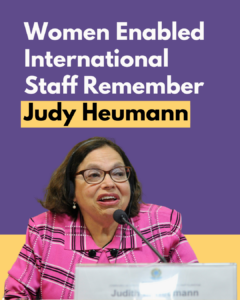
Against a purple and yellow background is a cutout photo of Judy Heumann speaking in a pink suit at a microphone behind a nameplate. Above, text reads, “WEI Staff Remembers Judy Heumann”

We at Women Enabled International are mourning the loss of Judith “Judy” Heumann, the Mother of the disability rights movement, who passed away March 4, 2023.  Her unwavering commitment to advancing human rights was immeasurable, and her passing has left a deep impact on all of us, both personally and professionally. It is an honor to celebrate her life and legacy this International Women’s Day.

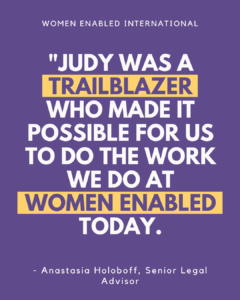
"Judy was a trailblazer who made it possible for us to do the work we do at Women Enabled today."

“Judy was a trailblazer who made it possible for us to do the work we do at Women Enabled today,” said Anastasia Holoboff, Senior Legal Advisor at WEI. “Her advocacy, leadership, and pioneering intersectional approach to disability rights are guideposts for all of us in a field where the wins are infrequent and the obstacles at times feel insurmountable.”

Judy’s legacy in the global disability and gender justice movements is unparalled. From the 504 sit-ins in San Francisco to her work at the State Department and her role in influencing disability rights policy around the globe, her fierce determination and indomitable spirit changed the course of history and paved the way for so many of us.

While Judy’s impact was global, she built it in a profoundly personal manner. Despite her prestigious and iconic status, she valued the individual stories and personal connections she made with everyone she met. 

“Judy was the Mother of the disability rights movement, but she knew the power of collective leadership. It wasn’t all about her. That’s what set her leadership apart. She valued getting to know people on a personal level.” Dr. Janie Mejias, Coordinator for the US Alliance, stated. “Even though we’re all working towards the same goal in the movement, we all have our own individual stories. And Judy took the time to get to know those stories and get to know the people.”

Today, we want to honor Judy’s legacy by sharing quotes and stories directly from WEI staff about how Judy impacted their lives and our movement. We hope that by highlighting these personal stories, we can celebrate and honor a few of the personal connections that Judy made throughout her life and the stories she leaves behind. 


AM Judy Quote

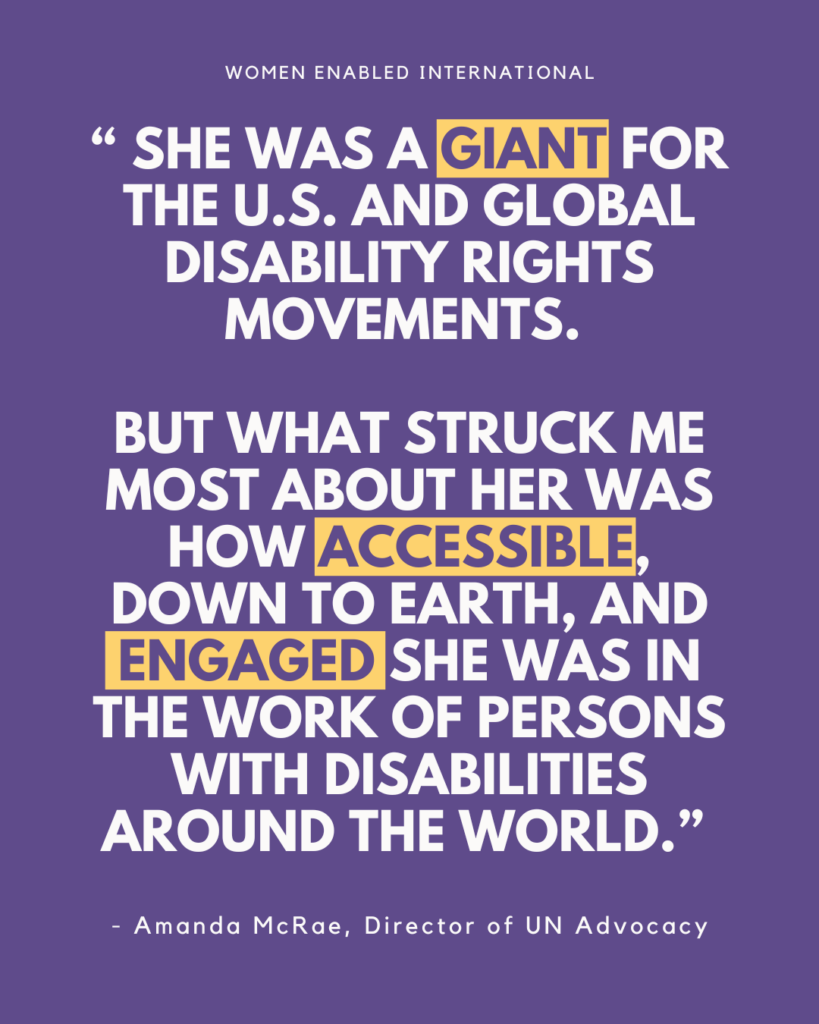
“I first met Judy in 2010 at the Conference of States Parties to the CRPD. She was a giant, for the US and global disability rights movements. But what struck me most about her was how accessible, down to earth, and engaged she was in the work of persons with disabilities around the world.” – Amanda McRae, Director of UN Advocacy

“Despite her stature in the movement and busy schedule, Judy always took the time to mentor and support young advocates, which just speaks to her incredible generosity of spirit and style of leadership. Her reaching out to me directly to congratulate me on the publication of the WEI-UNFPA Guidelines, will always be one of the highlights of my career. Her physical presence in our movement will be deeply felt and missed going forward, but we will always be guided by the lessons she shared and her legacy.” – Anastasia Holoboff, Senior Legal Advisor

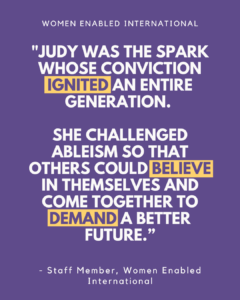
"Judy was the spark whose conviction ignited an entire generation. She challenged ableism so that others could believe in themselves and come together to demand a better future.” - Staff Member, Women Enabled International“Judy was known for her tenacious, wont-back-down advocacy in the face of adversity. But I think what made her ‘the mother of the movement’ was her ability to connect on a personal level. Whether it was to sway a government official or ask each activist to keep fighting, even for just one more day. That’s how she built the movement, by individual invitation.” – Brittany Evans, Communications Manager
One staff member shared, “her unwavering commitment to intersectionality showed us that we can’t fight for justice in silos.” Another said, “Judy was the spark whose conviction ignited an entire generation. She challenged ableism so that others could believe in themselves and come together to demand a better future.” 


At WEI, we’re still grappling with this profound loss. Judy’s presence in our community felt as immortal as her impact. Just weeks ago, Judy reached out to our new executive director, Maryangel García-Ramos.

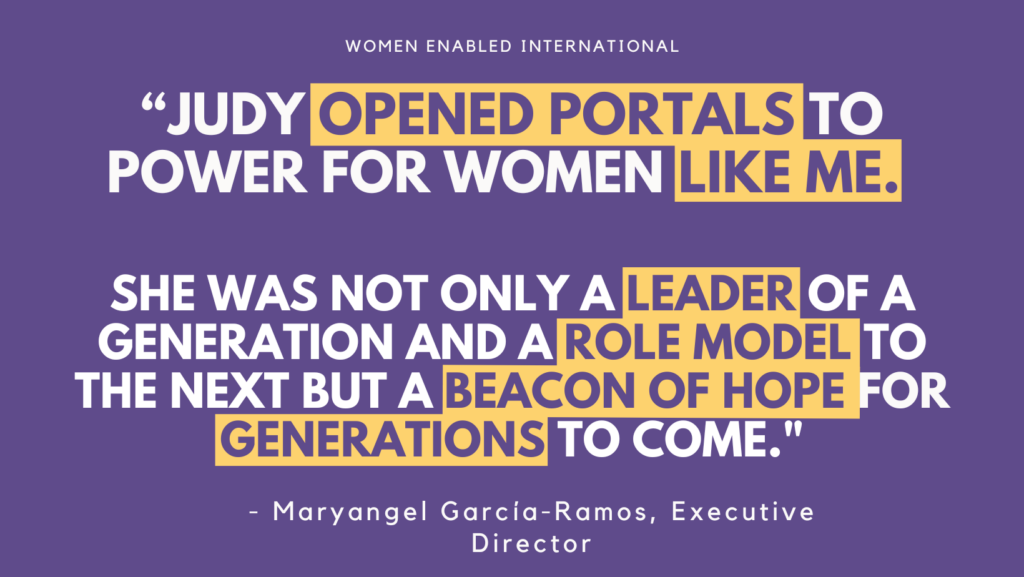
“Judy opened portals to power for women like me. Her kind words to me directly, as a fellow disabled feminist leader, were a profound moment of solidarity and mentorship. It’s a testament to her commitment to nurturing disabled leadership. She was not only a leader of a generation and a role model to the next but a beacon of hope for generations to come.”

“Judy opened portals to power for women like me. She was not only a leader of a generation and a role model to the next but a beacon of hope for generations to come." - Maryangel García-Ramos, Executive Director

We are honored to have had the opportunity to know and learn from Judy. As we mourn the loss of such a titan of the disability rights movement, we are called to action, to continue her work, to honor her memory, and to create a world that is more just, equitable, humane, and inclusive for all of us in all our diversity. 

Rest in power, Judy. 


We hope you find as much joy in this video of the Heumann Perspective featuring our founder, Stephanie Ortoleva, talking about WEI as we do!

Are you attending the 67th session of the Commission on the Status of Women (CSW67) from March 6-17, 2023?

If so, come say “hi” to WEI!

Women Enabled International (WEI) will host and participate in various events, meetings, and social media campaigns during CSW67. In line with the theme of this year’s gathering, our engagement will highlight the link between technology and innovation and the disability-related accessibility of key decision-making spaces.

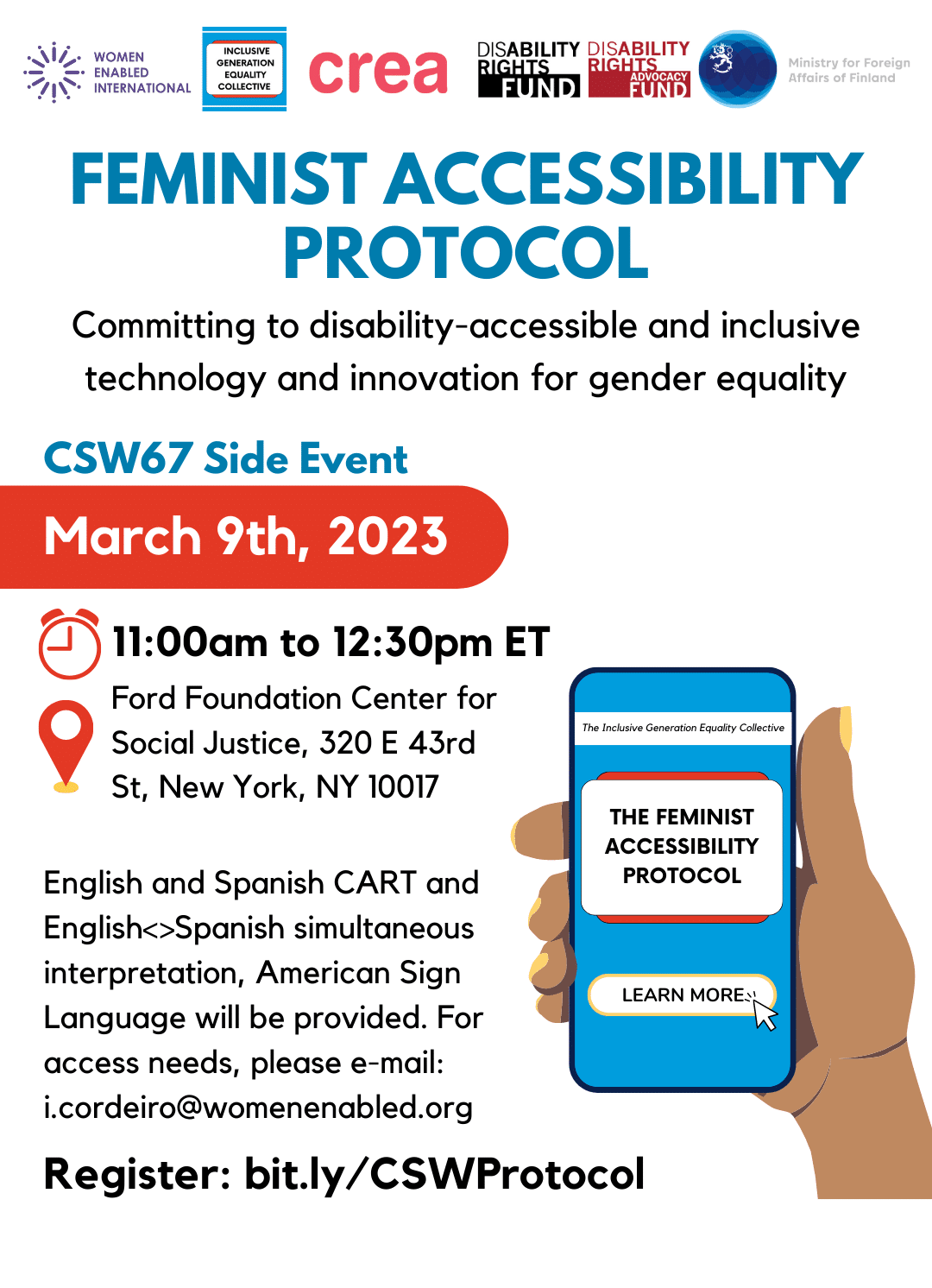
Flyer with event information, sponsor logos, and a graphic of a hand holding a phone with the screen showing the cover of the Feminist Accessibility Protocol.One of the events we’re most excited about is our own – “Feminist Accessibility Protocol – Committing to Disability-accessible and Inclusive Technology and Innovation for Gender Equality and Human Rights

The in-person event will introduce the Feminist Accessibility Protocol and bring together voices from States, UN agencies, feminist civil society, and disabled feminists to highlight good practices utilizing technology and innovation to ensure an accessible, inclusive, valuable, and safe space for feminists with disabilities. CART closed captioning in English, American Sign Language interpretation, and English-Spanish interpretation will be provided.

When: Thursday, March 9, from 11:00 am to 12:30 pm EST
Where: Ford Foundation Center for Social Justice, 320 East 43rd Street.

To register for this event, visit this link: www.bit.ly/CSWProtocol
Please note: registration will close 48 hours before the event.
In addition to our event, the creators of the Feminist Accessibility Protocol, The Inclusive Generation Equality Collective, will be launching two campaigns during the event, and we’d love for you to get involved!

The first campaign, #CommitToAccess, will encourage prominent feminists to commit to ensuring the accessibility and inclusion of feminists with disabilities in feminist spaces by signing the Feminist Accessibility Protocol.

The second campaign, #AccessInPractice, aims to see the Protocol in action by highlighting good practices and identifying accessibility barriers for the participation and leadership of feminists with disabilities at CSW67. Accessibility is a gender equality issue. It’s up to all of us to ensure that all feminists can participate fully and equally.

So, whether you’re attending #CSW67 in person or not, we’d love for you to join us! Encourage your network to #CommitToAccess and share your own experiences using #AccessInPractice.


Make sure to check out these other in-person events featuring the WEI team:

Advancing Feminist Movements and Leadership: Bringing Generation Equality to the Local Level
When: Tuesday, 7th March, 4:00pm to 5:00 pm EST
Where: Riverview Room, Millennium Hilton New York, One UN Plaza, 28th Floor
Organized by: United Cities and Local Governments (UCLG)

Gender Equality, Disability and the Digital World
When: Wednesday, 8th March, 12:30pm to 2:00pm EST
Where: Lower Level, Salvation Army International Justice Commission, 221 East 52nd Street,
Organized by: Women with Disabilities Australia (WWDA)

Feminists say “Enough!” Countering Anti-gender Forces and Fostering Collective Resilience
When: Friday, 17th March, 6:15pm to 7:30pm
Where: Church Center of the United Nations, 777 United Nations Plaza
Organized by: CREA

Join us virtually at these events:

Women with Disabilities, Access to Technology and Equality
When: Friday, 10th March, 8:00am to 10:00am EST
Virtual: Register with this [LINK]
Organized by: Shanta Memorial Rehabilitation Centre

Women with Disabilities Crossing the Digital Divide
When: Wednesday, 15th March, 11:00am to 12:30pm EST
Virtual: Register with this [LINK]
Organized by: International Convocation of Unitarian Universalist Women

Women Enabled International (WEI) extends our solidarity to the people of Turkey and Syria in the face of the devastating earthquakes that have impacted both countries. WEI expresses particular concern for the situation of women, girls, and gender-diverse people with disabilities in the aftermath of this natural disaster, particularly those who were already experiencing a heightened risk of human rights violations under armed conflict and displacement, as this emergency poses new threats to their rights, safety, and wellbeing.

In Syria, 28% of the population has a disability. In Turkey, there are about 5 million people with disabilities, 57 % of whom are women. Natural disasters, such as the earthquakes that affected these countries this week, can impact the rights and well-being of women, girls, and gender-diverse people with disabilities.  In particular, existing research indicates that, during situations of risk and humanitarian emergencies, women, girls, and gender-diverse persons with disabilities experience higher risks of violence than do other women and other persons with disabilities, face increased barriers to GBV and health services, including sexual and reproductive healthcare and gender-based violence services. They also experience greater difficulty meeting their basic needs. These risks chiefly arise due to preexisting patterns of discrimination, stigma, stereotypes, and prejudices at the intersection of gender and disability, among other statuses. 

Within this context, States must promote and protect the rights of women, girls, and gender minorities with disabilities during humanitarian emergencies like this. Under article 11 of the Convention of the Rights of Persons with Disabilities (CRPD),  State Parties have a specific obligation to take all necessary measures to ensure the protection and safety of persons with disabilities in situations of risk, including situations of armed conflict, humanitarian emergencies and the occurrence of natural disasters. Article 6 of the CRPD affirms that States must take specific steps to ensure the rights and safety of women and girls with disabilities.

With these obligations in mind, we call on governments and other stakeholders providing essential assistance in  Syria and Turkey to make sure that women and gender-diverse people with disabilities are included in response efforts. This includes: 

  • Ensuring the prompt, accessible, and safe evacuation and/or relocation of women, girls, and gender-diverse persons with disabilities from regions most severely impacted by the earthquake.
  • Ensuring that women, girls, and gender-diverse persons with disabilities are provided direct access to food, water, medical supplies, healthcare, accessible transportation, safe and accessible shelters, and other measures to reduce the impact of the emergency on their lives without discrimination based on their gender, disability and other statuses.
  • Preventing and redressing sexual and gender-based violence against women, girls, and gender minorities with disabilities, including by evacuating them, making humanitarian assistance directly available to them, and ensuring that evacuation shelters are fully accessible and do not expose them to heightened risks of gender-based violence. 
  • Providing information about humanitarian assistance and about the response to gender-based violence and sexual and reproductive health during and in the aftermath of the emergency in accessible formats, such as sign language, braille, Easy Read, and plain language, and make such information available in places where women, girls, and gender-diverse people with disabilities can access it.
  • Adopting a twin-track approach to respond to the needs of women, girls, and gender minorities with disabilities in all disaster response and recovery efforts, policies, and programming. Involve women with disabilities and their representative organizations in the design, implementation, and monitoring of such efforts, policies, and programs.


Further resources on gender, disability, and humanitarian emergencies :

Women Enabled International, Rights Violations in Conflict and Humanitarian Emergencies Factsheet (2020).

Inter-Agency Standing Committee, Guidelines: Inclusion of Persons with Disabilities in Humanitarian Action (2019).