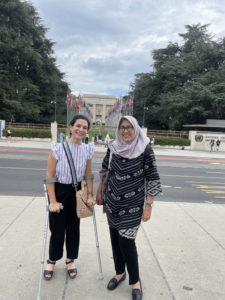
In August 2022, WEI traveled to Geneva for the first time since the start of the COVID-19 pandemic for an in-person session of the Committee on the Rights of Persons with Disabilities (CRPD Committee). We sponsored a colleague from the Indonesia Mental Health Association to participate in the CRPD Committee’s country review of Indonesia and adjacent meetings. The results of these joint advocacy meetings were: 

  • Drawing particular attention to violations of the rights of women, girls, and gender minorities with psychosocial disabilities, concerns that were reflected in the Committee’s concluding observations which called on the Indonesian government to address such abuses.  
  • Securing a long-sought meeting by Indonesia Mental Health Association with the Ministry of Social Affairs, which led to… 
  • Persuading the Ministry to conduct a joint site visit to an institutional facility to observe concerning conditions and take necessary follow-up steps to address them.  

Increasingly, WEI is working side-by-side with our partners to effectively advocate with international human rights bodies and also to keep the pressure on at the country level to hold governments accountable for upholding rights at the intersection of gender and disability. 


Hand holding phone with the Feminist Accessibility Protocol In keeping with the principle of “nothing about us with us”, we are proud to announce the launch of the Feminist Accessibility Protocol. This groundbreaking set of commitments seeks to address the persistent barriers that feminists with disabilities around the world have experienced in accessing gender equality spaces. WEI is a proud member and convenor of the Inclusive Generation Equality Collective, the group of advocates and allies for gender and disability rights and justice who came together to create this Protocol.

The Protocol is a historic initiative that asks States, feminist civil society, United Nations entities, and other actors to pledge to ensure that, moving forward, gender equality discussions and decision-making spaces are fully accessible to and inclusive of women, girls, trans, intersex and nonbinary persons with disabilities.  Each of the 13 pledges in the Protocol is a call for action on a specific aspect of accessibility and inclusivity in feminist events and meetings, including event planning, execution, and follow-up.  

To date, over 100 parties have signed on, including notable conveners like Women Deliver, AWID, and CREA.

Click here to read the full protocol, sign on, and share it with your organization and networks. 

In a collage of illustrations, two quotes from youth activists and focus group participants reading, "Thank you very much for inviting me to the focus group. It was very interesting to listen to different views.”"It would be great to have more discussions and really know what everyone's advocacy is and the amazing work they are doing!"  – youth activist and focus group participant 
Illustrations in the collage were created by a participant, Ritika Gupta.

In collaboration with 12 youth advocates with diverse disabilities from the US, Canada, Latin America, UK, Africa, India, Australia, New Zealand, and the Pacific, WEI undertook a project to adapt key resources about human rights at the intersection of gender and disability into more youth-friendly formats. Through surveys and a series of focus group consultations, we asked young people about the topics that interest them, their approaches to activism, and the most effective formats and channels for reaching their peers.

“Thank you very much for inviting me to the focus group. It was very interesting to listen to different views.” – youth activist and focus group participant

“It would be great to have more discussions and really know what everyone’s advocacy is and the amazing work they are doing!”  – youth activist and focus group participant

The young people’s feedback led to the creation of two new WEI learning resources in formats tailored for a younger audience: a digital action pack and an interactive online glossary, now available on the WEI website: 

Interactive Glossary: https://womenenabled.org/glossary/  

Digital Action Pack: https://womenenabled.org/digital-action-pack/  


These dynamic, digital, accessible, and youth-friendly tools will help empower new and emerging activists around the globe who are looking to advance disability rights and/or gender rights from an intersectional lens. This project was made possible through a Strategic Partnership Grant from the Disability Rights Fund, and WEI is excited about the potential for these to serve as a springboard for supporting and amplifying youth activism in our global movement. 

“We are confident that WEI together with youth activists have produced useful, interactive and dynamic youth friendly resources. We look forward to promoting these resources” – Christina Parasyn, Technical Assistance Director, DRF/DRAF 

The undersigned disability organizations are outraged and gravely concerned by today’s Supreme Court decision. The Dobbs v. Jackson Women’s Health Organization decision issued today will have devastating consequences. This decision overturns Roe and Casey and eliminates any federal right to abortion. In doing so, it puts many disabled people, particularly Black people, Indigenous people, and other people of color, LGBTQIA+ folks, immigrants, survivors of sexual assault, poor people, and our allies at risk for forced childbirth, death, criminalization, and other physical, emotional, and material harms.

People with disabilities have the fundamental right to make decisions about our lives and bodies. For women and other persons with disabilities who can become pregnant, this includes the right to decide whether or not to continue a pregnancy. People with disabilities are more likely to experience sexual assault, and people with some disabilities face increased and serious health risks from pregnancy. Disabled people need and deserve access to affirming and accessible reproductive health care services, including abortion.

Today’s Supreme Court decision also has far reaching consequences beyond abortion. This decision and its consequences should concern everyone invested in the constitutional rights to work, marry, have and raise children, and make personal decisions without governmental interference. It limits the zone of privacy as the decision drastically narrows the scope of rights protected by the Fourteenth Amendment’s Due Process Clause. At the core of the Dobbs v. Jackson decision is a disagreement with a series of landmark Supreme Court decisions, including those following Griswold v. Connecticut, 381 U.S. 479 (1965).

The decision upends a core value at the heart of American life and law: that we each enjoy the individual liberty to make certain personal decisions without government interference. The very lives of disabled people depend upon the ability to make personal decisions without interference – including decisions about our bodies and medical care. Decimating any aspect of this freedom is cruel, and undermines any claim by those who made this decision that they value privacy and liberty.

This decision also severely weakens stare decisis. With the weakening of stare decisis, the Supreme Court could decide to overrule existing legal precedent at any time, obliterating rulings that have been considered settled for generations. These drastic upheavals are severely detrimental to people who depend on the courts to enforce their civil rights, including disabled people and other historically marginalized groups.

Today’s case has far-reaching consequences. The majority’s opinion puts bodily autonomy and individual liberty in decision-making at risk and may have consequences that affect personal rights surrounding marriage, family planning, intimacy, sterilization, medical care, housing, speech, and more. This ruling is at odds with the Court’s previous decisions about personal autonomy and privacy over the last several decades. We cannot wait for a future Supreme Court to reverse this devastating decision. Congress must act to protect these important rights.

To protect our communities, we stand united in our opposition to this opinion and its unjust result. Our rights – and the rights of countless Americans – depend on it.

Signed,

American Association of People with Disabilities

Autistic Self Advocacy Network

Autistic Women and Nonbinary Network

Bazelon Center for Mental Health Law

Be A Hero

Center for American Progress

Disability Rights Education and Defense Fund Little Lobbyists

Women Enabled International

Logos for AAPD, ASAN, AWNN, Bea Hero, Bazelon Center, Cap, DREDF, Little Lobbyists, and WEI.


Text- The Fight does not end here. Reproductive Rights are disability rights.

Women Enabled International is deeply distressed by the Supreme Court of the United States’ decision in Dobbs v. Jackson Women’s Health Organization today, which overturns a nearly 50-year legal precedent and eliminates a federal right to abortion in the United States. As a result of this decision, abortion could become illegal or severely restricted in over half of U.S. states and territories, with devastating consequences for the lives and health of more than 40 million women and other people with the biological capacity to become pregnant.

Abortion is essential health care to which women and gender minorities—with and without disabilities—need safe and legal access in order to exercise control over our bodies and lives, live with dignity, and achieve full recognition of our personhood. Restrictions on access to abortion have a disproportionate impact on the lives and well-being of women and gender minorities with disabilities.

For example:

· Pregnant persons with disabilities may face significant health impacts and complications from pregnancy, including as a result of their impairments, and so may require access to abortion to ensure protection for their own health and lives.

· Persons with disabilities are at heightened risk of sexual violence and abuse; being forced to continue an unwanted pregnancy that results from that abuse may have significant mental and physical health impacts.

International human rights law affirms a right to reproductive autonomy and freedom. The realization of this right should not be contingent upon where we live. The Supreme Court’s decision, however, effectively requires a significant portion of the population to travel out of state to be able to exercise this right. Pregnant persons with disabilities face significant financial and logistical barriers to traveling to another jurisdiction to obtain an abortion, as travel may be too expensive, the means of travel may be inaccessible, and they may require a support person or interpreter to undertake such travel. Furthermore, some people with disabilities have trouble accessing needed information due to the inaccessibility of the way the information is presented or lack of financial resources for Internet access. This further complicates their ability to access out-of-state abortion care.

As a result of these significant barriers, pregnant persons with disabilities—particularly those who experience multiple forms of marginalization due to race, ethnicity, sexual orientation, gender identity or expression, age, or other statuses—will be denied their right to essential reproductive health care. As we have seen globally, people who cannot access legal abortion may resort to unsafe and/or clandestine abortions, with attendant risks to life and health, in addition to the threats of criminal charges.

The impact of this decision will be felt deeply across the United States and around the globe. WEI is committed to working in partnership with disability and reproductive rights and justice organizations across the country to mitigate the harmful effects of this decision on our community and to ensure that the voices and perspectives of women and gender minorities with disabilities are included in this important fight for our human rights.

In addition to WEI’s ongoing work to bring an intersectional gender and disability lens to discussions and advocacy around abortion rights, in the coming months we plan to:

· Give guidance to abortion funds about how to ensure that funding reaches and is inclusive of women and gender minorities with disabilities.

· Develop and disseminate accurate information about the impact of the Dobbs decision in accessible formats.

· Bring the learnings from our sisters in other countries who have participated in their countries’ movements for abortion rights to inform the longer-term response of U.S. disability rights and justice actors to this human rights crisis.

Today’s decision is a significant attack on our fundamental rights, and we share the pain, anger, and exhaustion that so many of you feel. But while this marks the end of an era in abortion rights in the United States, the fight does not end here—WEI remains committed to engaging in strategic and collective advocacy to reclaim our right to bodily autonomy.

WEI is excited to take part in this year’s Conference of States Parties (COSP) to the Convention on the Rights of Persons with Disabilities (CRPD)*  —the largest annual global gathering of States, civil society, UN agencies, and other actors dedicated to ensuring disability rights. After two years of virtual meetings, we will be returning in part to the United Nations Headquarters in New York —our first time back since 2019— while also hosting and co-hosting several virtual side events from June 13 to 17 for our entire global community.  

For this 15th session of COSP, the overarching theme is Building Disability-Inclusive and Participatory Societies in the COVID Context and Beyond. Subthemes include Innovation and Technology Advancing Disability Rights; Economic Empowerment and Entrepreneurship of Persons with Disabilities, and Participation of Persons with Disabilities in Climate Action, Disaster Risk Reduction, and Resilience against Natural Disasters. It is imperative to have the voices and perspectives of women, girls, and gender minorities with disabilities on each of these topics, and so we are energized to have WEI team members, together with partners and advocates on the ground to ensure we have a seat at the table. 

Please also join us online for our side-events! 

1. Generation Equality Comes to CoSP: Ensuring the Participation of Women, Girls, and Non-binary Persons with Disabilities in Advancing Gender Equality

Sponsored by the Generation Equality Action Coalition on Feminist Movements and Leadership.

What: Women, girls, and gender minorities with disabilities are an essential part of the movement for women’s rights and gender equality. The Generation Equality movement is working to accelerate gender equality through 2026, and feminists with disabilities are an imperative part of this work. Join the Generation Equality Action Coalition on Feminist Movements and Leadership to find out more about the Generation Equality process and how feminists with disabilities can be involved.
When: Monday, June 13, 10 am to 11:15 am (EDT)
Where: Zoom – Register here.

2. Equal Rights for Women and Girls with Disabilities: Leveraging the Power of Innovation and Technology to Ensure Access to Sexual and Reproductive Health and Rights

Co-sponsored by UNFPA, Finland, and WEI

What: Join the Permanent Mission of Finland, UNFPA & Women Enabled International for a rich discussion on good practices from around the world on leveraging the power of innovation and technology to ensure access to sexual and reproductive health and rights for women and girls with disabilities.
When: 16 June, 08.30 – 09.45 AM (EDT)
Where: Zoom – Register here.

3. Using Technology to Bring Together Women and Gender Minorities with Disabilities during the COVID-19 Pandemic

Co-sponsored by WEI, Canada, CREA, and Disability Rights Fund

What: Join WEI, CREA, Disability Rights Fund, and the Government of Canada for a CoSP15 side event where gender and disability rights advocates from around the world will be discussing the ways in which technology brought them together, the challenges it posed, and the good practices that remained.
When: June 17, 10 am – 11:15 am
Where: Zoom. Register here.

It’s official: the U.S. Alliance of Women, Nonbinary Persons, and Other Gender Minorities with Disabilities has launched!  Following months of research, community organizing, and steering meetings spearheaded by Women Enabled International, a diverse and dedicated group of feminists with disabilities in the U.S. has formed an Alliance to advocate on the critical human rights issues that affect the lives, experiences and opportunities of our community in the United States. 

WEI hosted a March 11 virtual gathering that was part launch event and part happy hour. In addition to formal remarks about the Alliance’s initial priorities and reflections on the process of building the Alliance, there were fun activities and socializing. Through a unanimous vote, members selected WEI to be Coordinator of the Alliance for the first three years. 

During a ‘scavenger hunt,’ Alliance members shared items connected to the disability rights and justice movement, which included voicing hopes for the Alliance, introducing service animals and pets, and recommending favorites. One-member shared Disability Rights Activist Laura Hershey’s resonant poem “You Get Proud by Practicing.” 

The event culminated in a dance/listening party with a playlist compiled by Alliance member Shameka Andrew, featuring anthems and rallying cries such as: “Talkin Bout a Revolution” by Tracy Chapman, “Warrior” by Scandal, and Cheryl Crow’s version of the Beatles’ “Here Comes the Sun.”  The YouTube playlist included lyric captioning for each song to ensure that the music was accessible to all. 

By all accounts, the event was a success, and the community is energized. Here is what they had to say:

“I’ve been part of the disability community for a while and I’ve never been a part of such an intersectional group of women.  I’m really excited about that and I’m really hoping that we’re able to start some real change.”

Ashley Volion, Policy Analyst at Disability Rights Louisiana, who identifies as a Filipina/White with Cerebral Palsy.


“The best part about this [Alliance] and the work we get to do is since we are starting brand new, we literally get to mold it!” Jessica Jimenez, board member at the World Independent Living Center Network (WIN), who identifies as a Mexican female/gender-nonconforming person with epilepsy.


“A lot of disability-led organizations are still very top-down, and the way that this group is being developed has been led by the whole group…With this being such an intersectional group, the priorities reflect our community as a whole and not just the priorities and the goals of a small section of those with the most privilege.  So that really excites me… the work that we do is going to be really in touch with what the community wants and what we want.” 

Lindsay Baran, disability activist and Policy Director at NCIL, chronically ill and hard of hearing.

 Understanding the situation on the ground—and the needs and priorities of our community—is essential to effecting change. This is why field research is an important tool for human rights advocates. But the pandemic upended the traditional ways in which we conduct this work.  

 WEI’s Pacific Project —which began pre-pandemic— includes extensive research into the issues impacting women and young people with disabilities in several Pacific Island Countries. Our partnerships in the region became even more essential when COVID-19 struck and travel to and within the region was no longer possible. Implementing field research meant close collaboration with trusted colleagues on the ground. 

 Now, after two years of interviews, focus group discussions, and stakeholder meetings, the results of this work are being launched and disseminated to advocates, allies, policy makers, and service providers, both in the region and to the WEI community globally. 

 One such groundbreaking resource documents the particular barriers that women and young people with disabilities face in Samoa (including during the pandemic). This report was developed by WEI in close consultation with our regional partner, the Pacific Disability Forum (PDF), a Samoan disabled persons organization, Nuanua O Le Alofa (NOLA), and the United Nations Population Fund (UNFPA)’s Pacific Sub-regional Office (UNFPA-PSRO). 

Among the issues prioritized by women and young people with disabilities in Samoa in interviews were: 

  • stigma and discrimination, 
  • limited access to justice, 
  • no access to family life education,
  • multiple barriers to accessibility, including physical, and communications barriers to exercising sexual and reproductive rights and their right to be free of violence.
Know Your Rights Illustration
Women, girls and gender non-conforming persons with disabilities: Know Your Rights!

A key finding from this research is that women and young people with disabilities need access to easily digestible information about their rights—including rights during the COVID-19 pandemic. So alongside of the country-specific reports, WEI developed a Know Your Rights guide in partnership with PDF and UNFPA-PSRO and with the support of the Australian Department of Foreign Affairs and Trade.  

“Working with WEI has become a very powerful experience for Mexicanas con Discapacidad,” says Mexicanas con Discapacidad founder, Maryangel García Ramos Guadiana. A longtime WEI partner, her organization recently worked side-by-side with WEI to develop and deliver a report to the UN Committee on the Rights of Persons with Disabilities (CRPD Committee) during its 26th session in March. WEI was there to support our partners and ensure the inclusion of a gender perspective throughout the CRPD Committee’s meetings.

Mexico was among the countries due for review by the CRPD Committee this session, and the report by WEI and Mexicanas con Discapacidad drew attention to the serious human rights issues facing people living at the intersection of gender and disability in Mexico. Our report also spelled out clear recommendations for holding the State accountable for ensuring the human rights of all its citizens.

The report addressed a number of issues impacting the rights of women and gender minorities with disabilities in Mexico: the importance of collecting disaggregated data on the lived experiences of women, girls, and gender minorities with disabilities, prevention of gender-based violence and access to justice for survivors, access to sexual and reproductive health and rights, the ability of individuals to exercise legal capacity, and the impact of COVID-19. Read the report here.

WEI also collaborated with Mexicanas con Discapacidad to speak out during a meeting with civil society organizations engaged in disability rights advocacy with the CRPD. We used this valuable opportunity to raise awareness of these issues and galvanize broader support for rights at the intersection of gender and disability.

Picture
Picture Of Maryangel García Ramos Guadiana at a Women’s March that reads “Sin números, somos invisibles” (Without data, we’re invisible).

“Together, we have been able to give visibility to the issues women with disabilities go through in Mexico from the eyes of civil society, this time, through our report to the CRPD Committee. This surely has given a unique and real perspective for the country’s review and provided insight into what still needs to be done for our community. Together we are more powerful, and our voices even louder.” 

Maryangel García Ramos Guadiana, founder, Mexicanas con Discapacidad

Human Rights Organizations Intervene in Cases Before the European Court of Human Rights on Poland’s Abortion Law

26 January 2022 – One year after the ruling of Poland’s discredited Constitutional Tribunal banning access to abortion in almost all circumstances took effect, its devastating impact on the lives of women and all those in need of abortion care continues. The ruling has increased the extreme barriers women seeking access to abortion face and has had tragic consequences for many of them and their families.

Since the ruling took effect on 27 January 2021, more than 1000 women have turned to the European Court of Human Rights in an effort to vindicate their rights, challenging Poland’s highly restrictive abortion law and seeking justice. These groundbreaking cases mark the first direct challenges to be filed before the European Court against Poland’s highly restrictive abortion law and the 2020 Constitutional Tribunal ruling. The applicants claim that the Polish abortion law causes them grave harm and violates their rights to privacy and freedom from torture and other ill-treatment. The Court is expected to begin ruling on some of these cases: K.B. v. Poland and 3 other applications; K.C. v. Poland and 3 other applications; and A.L.- B. v. Poland and 3 other applications.

Nine leading international human rights organizations have filed third-party interventions to the European Court of Human Rights in these cases, including Amnesty International, the Center for Reproductive Rights, Human Rights Watch, the International Commission of Jurists (ICJ), the International Federation for Human Rights (FIDH), the International Planned Parenthood Federation European Network (IPPF EN), Women Enabled International, Women’s Link Worldwide, and the World Organisation Against Torture (OMCT). The interventions provide evidence and analysis drawing on international human rights law, comparative European law and guidelines from the World Health Organization. They outline the profound implications that highly restrictive abortion laws have on the lives and health of women and girls of reproductive age.

Restrictive abortion laws such as Poland’s are contrary to international and European human rights standards and public health guidelines. They compromise women’s freedom, dignity, health, and lives. Our organizations’ interventions seek to highlight critical human rights aspects of such restrictive laws, and we are proud to support efforts to hold Poland accountable for these ongoing human rights violations, the organizations said.

Background

Poland has one of Europe’s most restrictive abortion laws. Together with Malta, it is one of only two European Union Member States that has not legalized abortion on request or broad social grounds. In Poland, abortion is only permitted in situations of risk to the life or health of a pregnant woman, or if a pregnancy results from rape. In practice, however, it is almost impossible for those eligible for a legal abortion to obtain one. Every year thousands of women leave Poland to access abortion care in other European countries, while others import medical abortion pills or seek extra-legal abortion in Poland. Polish women, particularly those in difficult socio-economic situations, have to depend on the crucial help from civil society organizations, with often limited resources.

On 22 October 2020, Poland’s discredited Constitutional Tribunal ruled that abortion on grounds of “severe and irreversible fetal defect or incurable illness that threatens the fetus’ life” was unconstitutional. The ruling followed a case filed by members of the Polish Parliament and formally supported by the Prosecutor General. The ruling came into force on 27 January 2021. Both the European Court of Human Rights and the European Commission have found that the Constitutional Tribunal does not meet fair trial requirements due to its lack of independence from the legislative and the executive powers.

The ruling eliminated one of the only remaining legal grounds for abortion under Poland’s highly restrictive law and its entry into force means that there is now effectively a near-total ban on abortion in Poland. Previously, over 90 percent of the approximately 1,000 legal abortions annually performed in Poland were on this ground. The ruling came as the COVID-19 pandemic restrictions made travel for abortion care prohibitively difficult and costly. It spurred the country’s largest public protests in decades, led by women human rights defenders. Activists and women’s rights organizations report that the ruling is having a significant chilling effect as medical professionals fear repercussions even in situations where abortion remains legal. Women human rights defenders and civil society organizations advocating for the ruling to be overturned and for reform of Poland’s abortion law have faced threats of violence and several protestors have been prosecuted.

Read the third-party submissions here.

For more information about the cases filed by 12 Polish women see:

For more information on the developments following the Tribunal’s ruling see e.g.: https://reproductiverights.org/poland-a-year-on-abortion-ruling-harms-women/ https://ec.europa.eu/commission/presscorner/detail/en/ip_21_7070

For more information, please contact:

For Amnesty International, Stefan Simanowitz: press@amnesty.org, Twitter: @amnestypress

For the Center for Reproductive Rights, Cathy Bartley: cathy.bartley@bartley-robbs.co.uk and Center.Press@reprorights.org, or +44 7958 561671

For Human Rights Watch, in London, Hillary Margolis: margolh@hrw.org; +44-773-348-6524 or +1-917-385-4107, Twitter: @hillarymargo; in New York, Aisling Reidy: reidya@hrw.org, +1 917 378 3178

For the International Commission of Jurists (ICJ), Ian Seiderman: iseiderman@icj.org

For the International Federation for Human Rights (FIDH), Eva Canan: ecanan@fidh.org, +33 6 48 05 91 57; Twitter: @fidh_en.

For the International Planned Parenthood Federation European Network, Irene Donadio: idonadio@ippf.org, +32 491 71 93 90, Twitter: @ippfen

For Women Enabled International, Brittany Evans: b.evans@womenenabled.org

For Women’s Link Worldwide, Laura Martínez: l.martinez@womenslinkworldwide.org, or +34 699 984 800. Twitter: @womenslink

For the World Organisation Against Torture (OMCT), Iolanda Jaquemet: +41 79 539 41 06, ij@omct.org, Twitter: @omctorg