New amicus curiae brief before the Texas Supreme Court

Women Enabled International (WEI), the Disability Rights Education and Defense Fund (DREDF), and the Texas Civil Rights Project (TCRP) filed an amicus brief on behalf of eleven disability rights organizations and scholars in the Texas Supreme Court, advocating for an interpretation of the medical exception to the state’s abortion ban that is inclusive of both the life and health of the pregnant person. The brief highlights the disproportionate impact of the ban on individuals with disabilities, who are more likely to rely on medical exceptions than non-disabled individuals.

About the case

The Center for Reproductive Rights filed Zurawski v. State of Texas on March 6, 2023 asking the state of Texas to clarify the scope of the “medical emergency” exceptions under its abortion bans. The 22 plaintiffs represented in the case include 20 women who were denied abortion care in Texas–despite risks to their health, fertility, and lives—and two Texas obstetrician-gynecologists who have been unable to provide abortion care under the bans. The case, filed in state court in Austin, is the first lawsuit brought on behalf of women denied abortions since the U.S. Supreme Court eliminated the constitutional right to abortion in Dobbs v. Jackson Women’s Health on June 24, 2022.

While Texas’ three laws banning abortion contain exceptions for the life and health of the pregnant person, the confusing language of these medical exceptions, coupled with harsh professional, civil, and criminal penalties and Texas’s hostile abortion landscape, deter doctors from providing abortions even where medically necessary. The plaintiffs argue that Texas’s abortion bans contain conflicting language and non-medical terminology, making it unclear when physicians are permitted to provide care under the laws’ “medical emergency” exception; therefore, the court’s interpretation should allow physicians to exercise their good-faith judgment regarding what patients qualify under medical exceptions.

On August 4, 2023, a Texas district judge issued an injunction blocking Texas’s abortion bans as they apply to dangerous pregnancy complications, clarifying that doctors can use their own medical judgment to determine when to provide abortion care in emergency situations. The ruling also denied the state’s request to throw out the case, and it found S.B. 8—Texas’s citizen-enforced abortion ban—unconstitutional. The state immediately appealed the ruling to the Texas Supreme Court, blocking it from taking effect. On November 28, 2023, the Texas Supreme Court heard oral arguments on the state’s appeal of the district court’s ruling and the case is currently awaiting the Supreme Court’s ruling.

About the amicus curiae brief

An amicus curiae (“friend of the court,” in Latin) is a person or organization that has a strong interest in the issues brought up in a case to which they are not a party. The amicus curiae may submit a written report setting forth its interpretation of the law or arguments relating to the facts under consideration by the Court.

WEI, DREDF, and TCRP have filed an amicus brief with eight other disability rights organizations and scholars including:

  • The American Association of People with Disabilities
  • The Autistic Self Advocacy Network
  • Autistic Women & Nonbinary Network
  • The Bazelon Center for Mental Health Law
  • Disability Rights Advocates
  • The National Health Law Program
  • Professor Ruth Colker (JD)
  • Professor Robyn M. Powell (PhD, JD)

The amicus brief that restrictions on legal access to abortion place an undue burden on individuals with disabilities, who often require specialized medical care and may face additional challenges in carrying a pregnancy to term. The amicus brief urges the Texas Supreme Court to interpret the medical exception to the abortion ban in a manner that upholds their rights and safeguards their well-being.

WEI, DREDF, and TCRP’s amicus brief argues the following key points:

  • Texas’ abortion bans and the current confusion regarding the applicability of the medical exceptions create a healthcare crisis that disproportionately harms people with disabilities. People with disabilities are more at risk for severe maternal morbidities and maternal mortality during their pregnancies than non-disabled people and pregnancy can worsen disability-related health outcomes.
  • Texas’ abortion bans exacerbate the harms that people with disabilities already encounter, given widespread discrimination and barriers to accessing abortion care (including travel- related and financial barriers). The combined effect of the chilling effect on the provision of abortion care due to Texas’ laws and barriers to accessing care is that people with disabilities are at high risk of total denial of medically necessary abortion care within Texas.
  • Restricting access to abortion care does not protect people with disabilities or advance any claimed state interest in opposing discrimination. Both the disability rights movement and the reproductive justice movement are united in the pursuit of autonomy, dignity, equality, and self-determination.
  • Disabled people have the right to protect their life and health under both the Texas Constitution’s Due Course Clause and Equal Protection Clause.

The amicus brief can be viewed here.
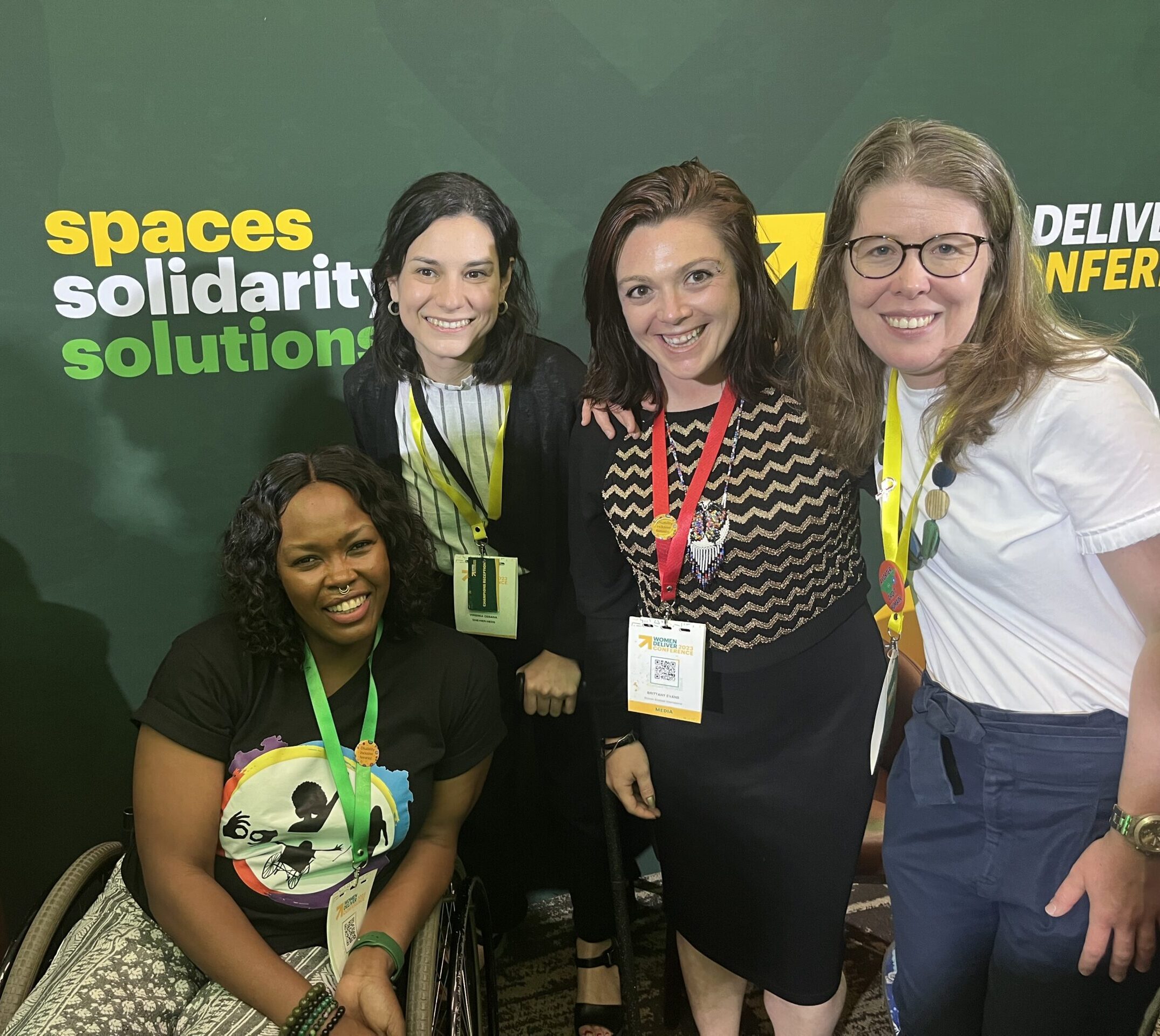
Welcome to this special edition of our “Community Corner,” where we shine a spotlight on the inspiring advocates who make our mission possible. Today, we celebrate the voice, leadership, and passion of Shiela May Aggarao, a member of the Inclusive Generation Equality Collective (IGEC). Her fearless advocacy at the Women Deliver conference is an embodiment of the strides we’re making toward an inclusive and just world. 

Introducing Shiela May Aggarao 

Meet Shiela! Shiela’s journey is one of global and local advocacy, passion, and inclusion. She represents not one but three incredible organizations, all striving for a more accessible and just world.

Women Deliver: A Milestone for Accessibility

The Women Deliver conference marked a significant stride towards accessibility by being the first to sign on to the Feminist Accessibility Protocol. Reflecting our values of inclusion, it set an exemplary standard by committing to creating an accessible environment for all conference attendees.

Shiela’s Purpose at the Conference 

Watch as Shiela describes her reasons for attending the conference: to promote the Feminist Accessibility Protocol and to emphasize the importance of intersectionality.

Unraveling the Feminist Accessibility Protocol 

The Feminist Accessibility Protocol is not just a framework; it’s a beacon of equality, autonomy, and collaboration:

  • Intersectional Understanding: Embraces the diverse experiences of women and gender-diverse people with disabilities, ensuring their active participation in decision-making.
  • Promoting Autonomy: Values and supports the autonomy of each individual, acknowledging their unique leadership and perspectives.
  • Inclusive Commitment: Addresses various barriers to create a world where everyone has an equal opportunity to thrive.
  • Collaborative Growth: Engages all stakeholders in a collective journey towards lasting change.

An Invitation to Act 

Shiela invites everyone to be a part of this transformation by signing the Feminist Accessibility Protocol. Her call resonates with urgency and hope, marking a path toward a more inclusive and just world.

Join the Movement

With pioneers like Shiela and Women Deliver, we’re building a world that embraces, includes, and celebrates all.

Discover more and sign on to the Feminist Accessibility Protocol here and be part of this transformation.

Together, we’re not just advocating change; we’re living it. Join us!

Generation Equality is the most significant ongoing global effort to advance gender equality. A 5-year initiative, it brings together governments, international and United Nations agencies, NGOs, philanthropic organizations, and the private sector to accelerate progress towards gender equality by 2026.

Since the process began in 2020, WEI has been at the forefront, promoting the rights, priorities, inclusion, and leadership of feminists with disabilities in the movement.

Generation Equality LogoNow as we approach the midpoint of Generation Equality, it is time to reflect both on our progress to date and what more we need to do to ensure that women, girls, and gender-diverse persons with disabilities lead, participate, and are valued in feminist spaces.

As an active leader of the Generation Equality Action Coalition on Feminist Movements and Leadership, WEI helped shape a Blueprint under which States, UN agencies, and others would commit to advancing gender equality, including key principles like intersectionality and sharing power with those most excluded from the feminist movement. We are also working with other Action Coalition leaders — including new partners like Global Affairs Canada, United Cities and Local Governments, and Gucci, as well as old friends like CREA, Open Society Foundations, and UN Women — to turn the Action Coalition’s Blueprint into a reality.

Generation Equality has become a galvanizing force for the growing global movement of feminists with disabilities, including through the creation of the Inclusive Generation Equality Collective, a global group of feminists with disabilities and allies that was first convened by WEI in 2021. After many feminists with disabilities could not access one of Generation Equality’s key moments — a virtual Paris Forum hosted by France in 2021 – WEI and the Collective strategized to ensure that we would no longer be excluded from the spaces where decisions were made about our rights and well-being.

Inclusive Generation Equality Logo Through the Collective’s advocacy and communications, we made the inaccessibility of feminist spaces a key theme emerging from the Paris Forum and created momentum for a shift in how gender equality spaces operate.

Building on that momentum and with WEI’s support, in December 2022 the Collective launched the Feminist Accessibility Protocol, a groundbreaking set of 13 accessibility-related commitments that serves as a call for States, UN agencies, feminist civil society, and other feminist actors to #CommitToAccess in the spaces where gender equality is discussed and decisions are made.

Over 150 feminist actors have signed onto the Protocol to date, and the Collective has effectively used the Protocol to advocate for access, inclusion, and leadership at key gender equality spaces in 2023, most notably at Women Deliver and the UN Commission on the Status of Women.

As we move forward into the second half of the Generation Equality process, we will continue to strongly advocate for the inclusion and leadership of feminists with disabilities in global gender equality spaces and also to partner with women-led organizations of persons with disabilities on country-level advocacy projects to make gender equality a lived reality.

Disability inclusion took center stage at this year’s Women Deliver conference, one of the largest multi-sectoral convenings to advance gender equality. Thanks to WEI’s meticulous planning and tireless advocacy behind the scenes and our strong presence at WD2023 in Kigali, Rwanda this July, 6000+ global attendees witnessed the meaningful inclusion of persons with disabilities across all spheres of participation, in keeping with the conference theme: “Spaces, Solidarity, and Solutions.”

Three WEI advocates and This Ability KenyaAs a strategic partnership through participation on the Women Deliver Advisory Committee, and also as disability and accessibility experts, WEI co-designed and championed the accessibility strategy for the massive gathering. This included ensuring accessibility in all aspects of the event, from plenary and concurrent sessions, to community gatherings and side events.
As part of Women Deliver’s Communications and Advocacy Committee, WEI led a coordinated effort to integrate accessibility across communications – from registration materials, schedules, and pre-conference announcements – to on-site maps and signage, social media and press packets. These accessible communications amplified global messages of inclusivity and empowerment.

Proudly, we brought a member of the Inclusive Generation Equality Collective who was instrumental in the creation of the groundbreaking Feminist Accessibility Protocol. Read more about Shelia’s role at Women Deliver here. Notably, Women Deliver was the first to sign on to the Protocol and commit to making feminist spaces accessible for all.

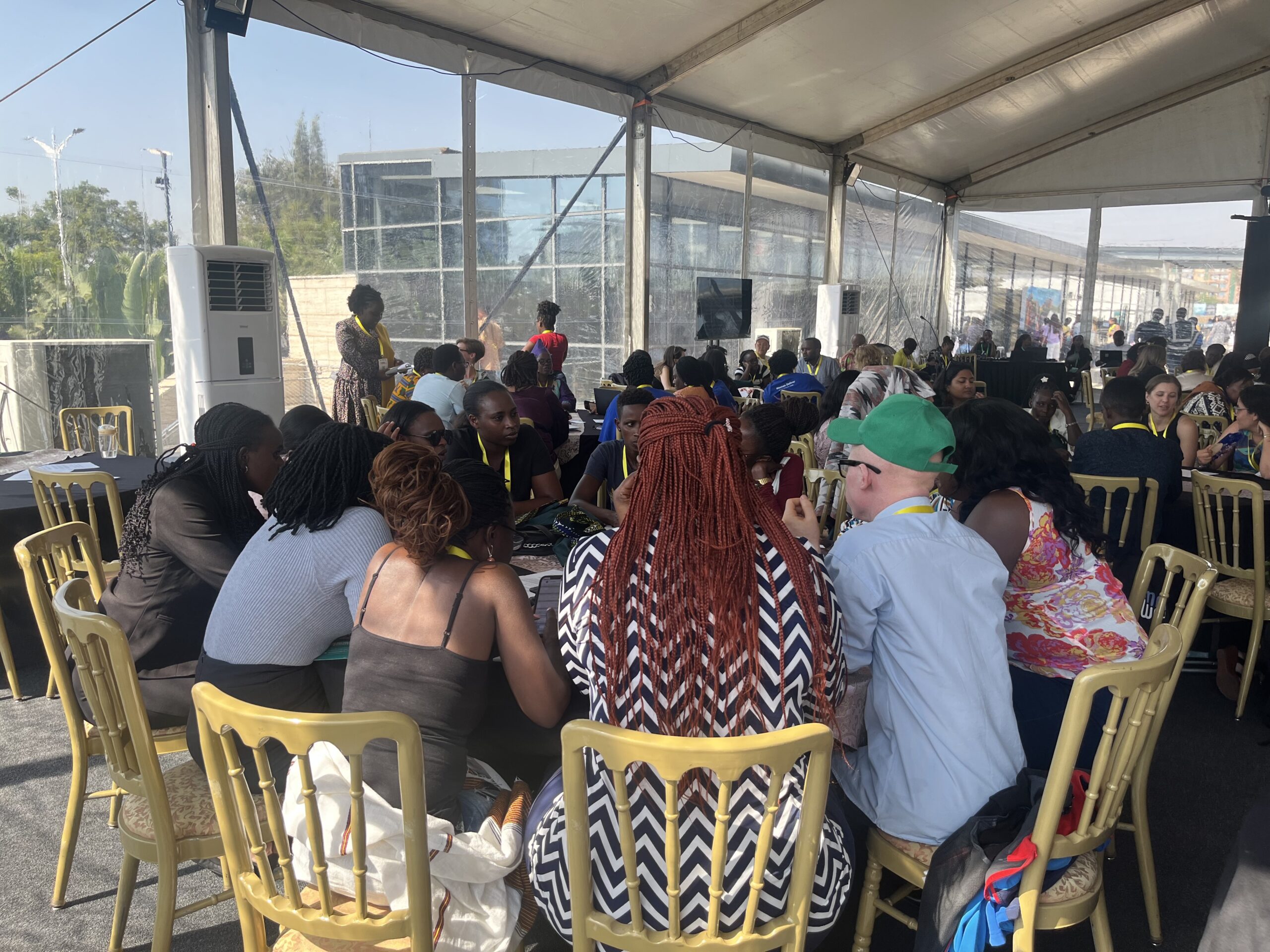
A full room at the Women Deliver Disability Solidarity Space. Our Disability Solidarity Space at Women Deliver 2023 was an inspiring and vibrant meeting ground where over 120 #FeministsWithDisabilities came together to share insights and build a community of connection.
Members of the WEI delegation were featured experts throughout the conference, including participating in panel discussions to promote intersectional advocacy efforts and the importance of collecting disability-disaggregated data. We hosted a virtual session that reached feminists with disabilities from all corners of the world, and Executive Director, Maryangel Garcia-Ramos was spotlighted as a plenary speaker on the topic of movement building.

Maryangel speaks into a microphone at Women Deliver.
Photo via Women Deliver.

Maryangel spoke of growing a movement alongside Stacey Abrams, Former Georgia State Representative; Liz Fraser, CEO & Brand President Kate Spade; Mabel Van Oranje, Founder and Board Chair of Girls Not Brides; Sr. Rosemary Nyirumbe, Founder of Sewing Hope Foundation; and Cleopatra Kambugu Kentaro, Director of Programs at East African Sexual Health & Rights Initiative. The space was moderated by international journalist Femi Oke, and the discussion included how we can build solidarity and join forces in order to shift power on an unprecedented global scale.

Explore our Instagram story highlights to relive these and other remarkable moments at WD2023. We extend our heartfelt gratitude to Women Deliver, fellow attendees, and the incredible community in Kigali, Rwanda, who made this conference inclusive, intersectional, and a resounding success!

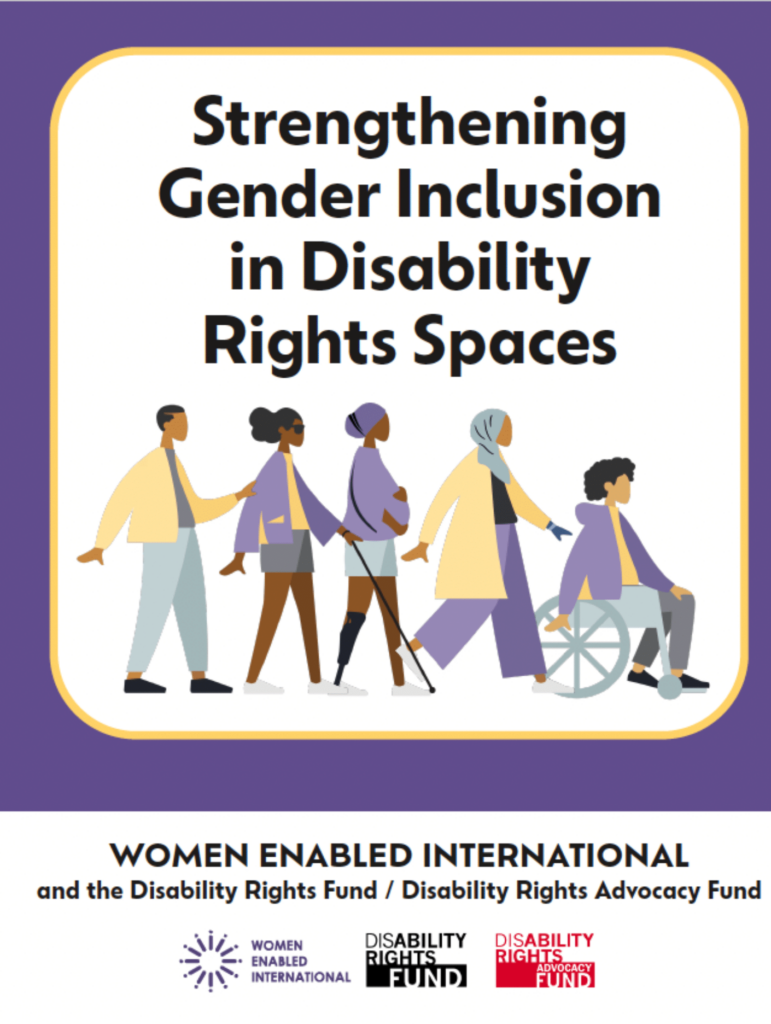
Strengthening Gender Inclusion in Disability Rights Spaces Report Cover

CoSP provided the perfect setting for WEI to launch our groundbreaking report on gender inclusion in mainstream disability rights spaces with our strategic partner, Disability Rights Fund (DRF)/ Disability Rights Advocacy Fund (DRAF).

The report details findings from WEI’s project to map primary barriers to gender inclusion, as identified by disability advocates from around the world, including Africa, Asia, the Pacific, and the Americas. Qualitative research was collected through virtual focus group discussions, individual interviews, and a written response from participants representing diverse demographics and disabilities.

Participants expressed numerous barriers to active participation in disability rights spaces, including:

  • Educational barriers, which impact self-esteem and capacity to engage in disability advocacy, e.g. a participant from the Philippines noted that only a small percentage of women with disabilities in her country finish high school.
  • Cultural and attitudinal barriers, as regional customs imply that women with disabilities shouldn’t speak in public. A participant from Kenya noted, “the leadership of the disability sector is generally male and because of patriarchy there are some topics that may be seen as not important.” Discrimination and social taboos prevent women and gender-diverse people with disabilities from speaking about the issues that impact them.
  • Siloed funding, as separate gender and disability portfolios among grant-makers pose a significant challenge to doing work at the intersection of gender and disability.

Beyond identifying the barriers, discussions with participating disability advocates also pointed to good practices for gender inclusion on disability rights spaces.

For example:

  • Centering voices and leadership of women, girls, and gender-diverse people with disabilities;
  • Strengthening the capacity and leadership of women, girls, and gender-diverse people with disabilities;
  • Strengthening the capacity of mainstream disability actors and funders to be gender inclusive; and
  • Increasing access to and utilization of technology.

This report charts a path forward for better integration of feminist disabled leadership in the disability rights movement. It concludes with targeted recommendations to the media, the donor community, governments, international non-governmental organizations, and organizations of persons with disabilities of all sizes.

Thank you to DRF/DRAF and to all participants of the focus group discussions and interviews, whose insights, experiences, and expertise made this report possible.

Click here to read the full report.

Representation is key – at all levels and in all spaces where disability and gender-related rights and justice are on the table. This was evident at the 16th Session of the Conference of States Parties to the Convention on the Rights of Persons with Disabilities (CoSP), held at the United Nations in New York this June. WEI staff hosted, sponsored, and participated in six events over three days, mobilizing our community and bringing critical perspectives and expertise at the intersection of gender and disability.

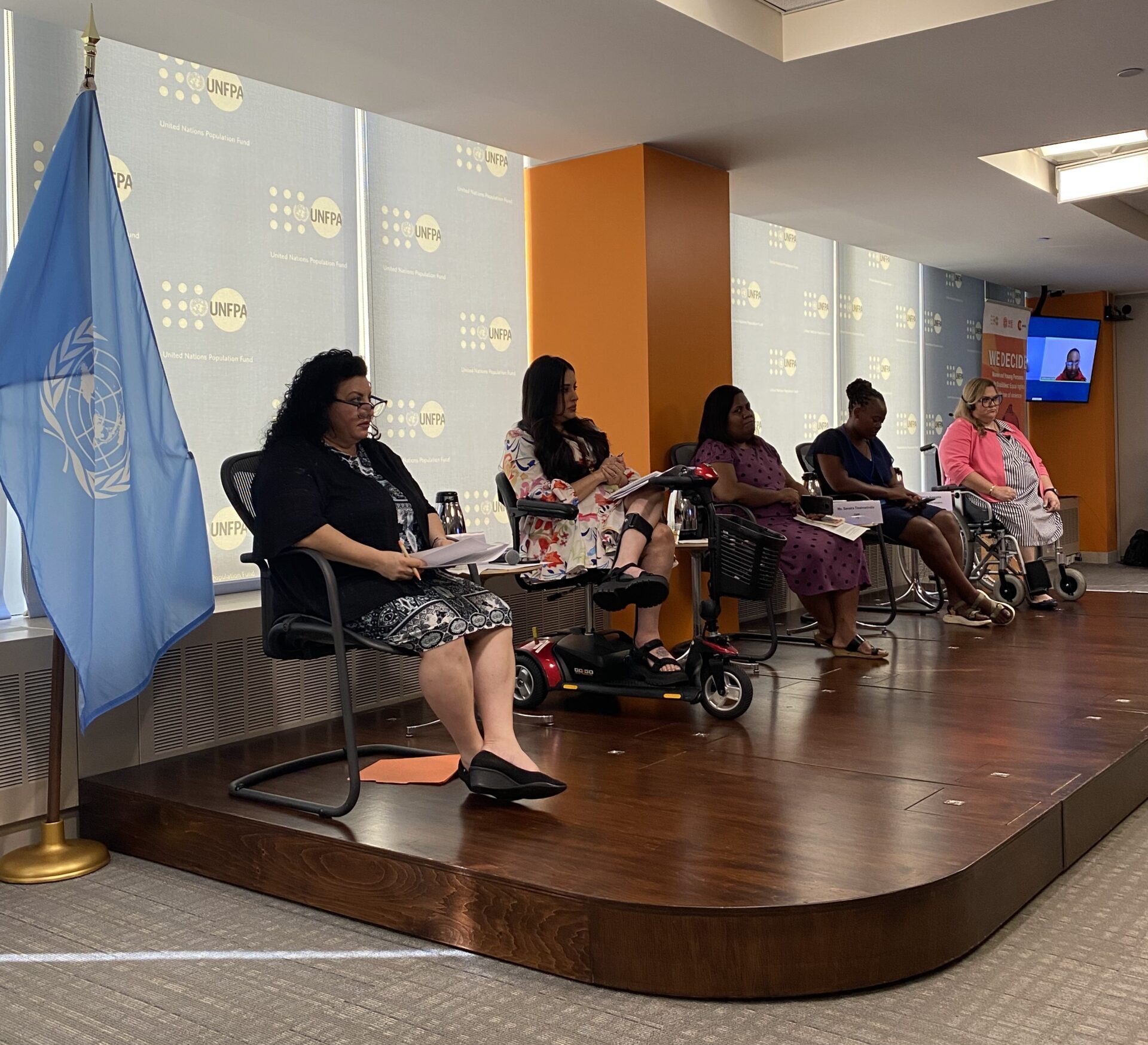
Five person panel at CoSP16.We organized and moderated a panel discussion on innovative interventions to ensure access to sexual and reproductive health (SRH), alongside panelists and co-sponsors from the United Nations Population Fund (UNFPA), the Permanent UN Missions of Finland, Norway, and Morocco, Validity Foundation, and advocates from Botswana, Fiji, and Latin America. They shared compelling results and good practices from interventions such as UNFPA’s global We Decide Programme and other on-going local projects that promote access to SRH and gender-based violence information and services for women, girls, and gender-diverse people with disabilities. They also made the case for more targeted research and data to strengthen access to comprehensive services.
WEI also worked with the UN Committee on the Rights of Persons with Disabilities to co-host a well-attended and well-received side event, “Stronger Together: Gender and Disability Intersectional Movements at the Forefront of Human Rights Advocacy.” During the event, we learned about the work of a deaf indigenous youth in Canada, from a queer disabled advocate in Kenya advancing rights through cross-religious understanding, and from an advocate with psychosocial disabilities working to transform communities for inclusion globally, all of whom are working across movements and issues to affect change. With a focus on where more intersectional advocacy is needed to meet increasingly-urgent global challenges, the event brought together a diverse set of co-sponsors committed to intersectional advocacy. The resounding response to this event proved that there is strong appetite for more of this work and for bringing feminist disabled leaders together in multi-stakeholder cross-movement collaborations in the future.

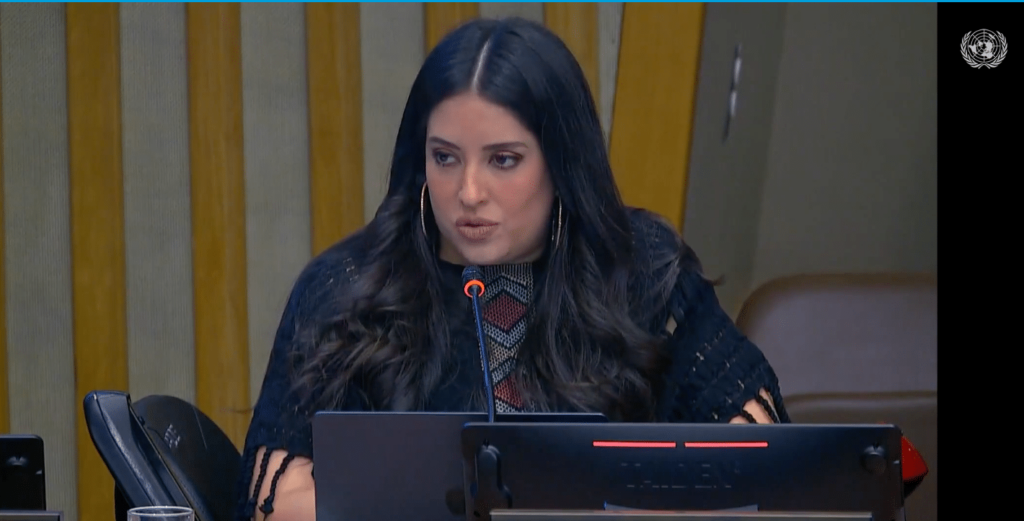
Screenshot of Maryangel addressing CoSP16

Another powerful moment was when WEI Executive Director Maryangel Garcia Ramos delivered remarks to the official roundtable meeting of States Parties. Her dynamic message advocated for intersectionality, inclusion, and disability justice. She asserted that the diversity of our movement is a strength and is integral to our goal of ending discrimination, while highlighting where the gender and disability intersectional movement is present and having a significant impact.

In each of these forums, WEI promoted the leadership of feminists with disabilities and sought to deepen connections across movements. Our goal was to ensure that the discussions, decisions, and outcomes at CoSP are not just inclusive – but also empowering and effective in their impact on individuals and communities worldwide.

Content Note: filicide, suicide, abuse 

Every year on March 1st, the disability community across the United States comes together to remember the victims of filicide: people with disabilities killed by their family members or caregivers. To honor the victims, WEI took part in a virtual vigil hosted by the U.S. Alliance (now formally known as U.S. Gender and Disability Justice Alliance) with support from ASAN (Autistic Self Advocacy Network (ASAN).  

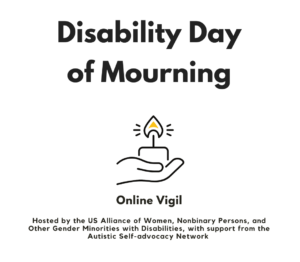
Disability Day of Mourning Flyer
The event details are written in black text against a white background. In the center is a line drawing of a hand holding a lit candle.

The event included a video tribute to the people in the disability community who were victims of filicide this year, created by ASAN. The moving tribute was followed by a candlelit moment of silence, remarks by US Alliance members, a poetry reading in memoriam, and an open opportunity for all to offer their words of support. The virtual space was comforting and inclusive, as everyone in attendance found strength in the sense of community. As one participant put it, “you are not alone in your fear, anxiety, and outrage.” 

Please take time to scroll through these names and lift them up with light and love: Link to an accessible PDF by the Autistic Self Advocacy Network that displays all of the names of people with disabilities who have been identified as victims of filicide. 

Additional resources for learning and advocacy:  

  • 988 Suicide & Crisis Lifeline: a United States-based network for confidential support to people in suicidal crisis or mental-health-related distress. It is available 24/7 by calling or texting 988. An international list of crisis hotlines is available here [LINK]. 
  • Disability Day of Mourning website: A memorial to the people with disabilities who were victims of filicide.  
  • Anti-Filicide toolkit by ASAN  

Stay tuned for more updates on US Alliance Webpage and Facebook page.  

Accessibility is a first – and non-negotiable – step. This is the message that WEI brought to Geneva in February on behalf of the Inclusive Generation Equality Collective. We were there to advocate for the inclusion of disability perspectives in the upcoming general recommendations of the Committee on the Elimination of Discrimination against Women (CEDAW) on the subject of “equal and inclusive participation of women in decision-making systems.” The general recommendation provides guidance to governments who have ratified the CEDAW Convention (known as ‘States parties’) on the measures they should adopt to ensure full compliance with their obligations to respect, protect and fulfill women’s human rights to equal and inclusive representation in decision-making systems. 

The crux of what WEI was advocating for is captured in the Feminist Accessibility Protocol [LINK], which essentially says that accessibility is a precondition for inclusion and lists 13 commitments for States, UN agencies, and feminist civil society to implement to ensure accessibility and a disability perspective in events and meetings on gender equality.  

IGEC member and CEDAW Committee member.
Gertrude Oforiwa Fefoame, member of the Inclusive Generation Equality Collective and CRPD Committe memeber, advocates for the rights of women and gender minorities with disabilities to the CEDAW Committee member Bandana Rana (Nepal)

Gertrude “Getty” Oforiwa Fefoame, Global Advocacy Adviser for Sightsavers in Ghana and a member of the Inclusive Gender Equality Collective, accompanied WEI on this mission and brought to bear her advocacy expertise, her personal lived experience, and her gravitas as a member of the UN Committee on the Rights of Persons with Disabilities.   

Getty delivered a powerful statement during the CEDAW Committee’s Half-day Discussion on Equal and Inclusive Participation of Women in Decision-making Systems, hosted by the Office of the High Commissioner for Human Rights (OHCHR). These speaking opportunities are highly coveted, as they will help inform the work on the upcoming general recommendation. Many organizations that had been slated did not have the chance to make their statements. Encouragingly, some others who did speak echoed Getty in advocating for inclusion of disability perspectives. 

“We are still fighting to enter decision-making spaces on an equal basis with others,” Getty testified, “a fight that pulls our attention away from the substantive contributions we can and should make to those spaces.”  

With WEI’s support, the Inclusive Gender Equality Collective and Getty secured individual meetings with 5 (of 23) CEDAW Committee members including, importantly, Nicole Ameline from France, who is serving as Rapporteur of the General recommendation. Ms. Ameline encouraged the disabled feminist movement to be ambitious in our advocacy, and we agreed that long term, we need to get beyond pursuing ‘a seat at the table.’ The first step in that direction, however, is to achieve accessibility – without which, our community gets persistently left behind. 

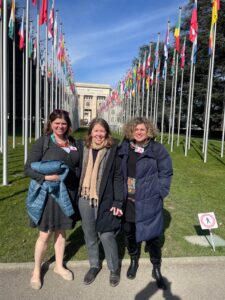
Three advocates outside the un on a sunny day.
Photo of Amanda McRae, WEI Director of UN Advocacy, and Sofía Minieri, WEI Legal Advisor, standing next to Polish advocate Magda Szarota in front of the Palais des Nations in Geneva, Switzerland, on a bright day.

Article 11 of the Convention on the Persons of Disabilities (CRPD) addresses Humanitarian Emergencies s and Situations of Risk. That is a big umbrella – striving to cover everything from armed conflict to natural disasters to climate change to global pandemics. 

The CRPD Committee, the body of independent experts that monitors implementation of the Convention, is developing a General Comment on Article 11 to provide guidance to governments on upholding rights in these wide-ranging contexts. Their process has entailed organizing regional consultations with organizations representing disabled people and briefings with key international advocacy groups – including Women Enabled International.  

Advocates at the CRPD Committee
Photo of advocates Magda Szarota and Sofía Minieri sitting alone among rows of tables in an amphitheater-style room briefing the CRPD Committee sitting out of frame.

WEI attended these briefings in Geneva with a partner advocate from Poland, Dr. Magda Szarota, who is supporting people with disabilities in Ukraine. Magda provided first-hand accounts of how small grassroots advocacy organizations were stepping in to fill a gap in humanitarian aid, as humanitarian actors still lack adequate knowledge on how best to support persons with disabilities, resulting in people with disabilities facing significant challenges to accessing the support and assistance they need.  

“We established an informal network of individual advocates and local disability organizations that have supported many Ukrainians with disabilities since the beginning of the war,” describes Magda. “However, we are ‘humanitarian amateurs.’ We have neither technical knowledge on humanitarian assistance nor the tools and resources to provide this assistance in a way that does not affect our mental health or compromise our own personal finances in a context of economic crisis.”  – Dr. Magda Szarota, Humanity in Action Polska, Board Member 

The CRPD Committee also issued a call for submissions, to which WEI substantively responded. Our submission points to the documentation of lived experiences at the intersection of gender and disability around situations of risk that we conducted, specifically related to the COVID-19 pandemic globally and to climate change as part of our needs assessment research in the Pacific region. WEI’s local partners provided additional expertise on the impact of humanitarian emergencies and situations of risk on gender and disability rights, particularly around gender-based violence and sexual and reproductive health. They added perspectives from multiple intersecting identities, including those who identify as members of indigenous and LGBTQIA+ communities. 

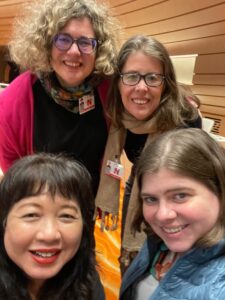
Four people smile for a selfie
Saowalak Thongkuay, Polish advocate Magda Szarota, WEI’s Director of UN Advocacy Amanda McRae, and WEI Legal Advisor, Sofía Minieri, smile together for a radiant selfie.

“Due to the impact of climate change, many indigenous women and girls with disabilities and their family members in Nepal cannot access nutritious and fresh food, including medicines and herbs from the forest these days. Every day, they are also compelled to walk more than 2-5 hours to fetch water, negatively impacting their health and menstrual hygiene.”   – President, National Indigenous Disabled Women Association- Nepal 

While the Committee grapples with how to make a General Comment on such a far-reaching and complex set of situations, WEI will continue to advocate and collaborate closely with the Committee in the coming months. We aim to ensure the final product makes visible the key issues impacting women and gender-diverse people with disabilities, recognizes the differentiated impacts of these issues on our community in humanitarian emergencies and situations of risk, and includes concrete, actionable recommendations.

Read Humanitarian Emergencies and Situations of Risk for Women, Girls, and Gender Diverse Persons with Disabilities: Submission for the CRPD Committee’s Day of General Discussion on Article 11

Protocol in Action

Three people smiling framed by purple.
Inside a purple and white frame with the WEI logo at the bottom, three advocates smile for a selfie during CSW67.

For two weeks in March, the 67th Session of the Commission on the Status of Women (CSW67) took place in New York City with the theme, “Innovation and technological change, and education in the digital age for achieving gender equality and the empowerment of all women and girls.” WEI brought a critical perspective to side events, panel discussions, networking, and social media, i.e. that accessibility is not just about accommodating disability – it’s about including and valuing the perspectives and experiences of feminists with disabilities.  

Throughout CSW67, WEI staff took every opportunity to lift up the Feminist Accessibility Protocol and to advocate for accessible technology as necessary to ensure all feminists can participate fully and equally. 

Our Flagship Event

WEI’s flagship event CSW engagement this year, “Feminist Accessibility Protocol – Committing to Disability-accessible and Inclusive Technology and Innovation for Gender Equality and Human Rights,” attracted 45 feminist actors, disability advocates, and funders. The event, held at the Ford Foundation Center for Social Justice, was moderated by WEI’s Maryangel Garcia-Ramos and included insights from the UN Women Executive Coordinator for the Generation Equality Forum and representatives of the IGEC, the Permanent Mission of Finland, the Disability Rights Fund, and CREA.

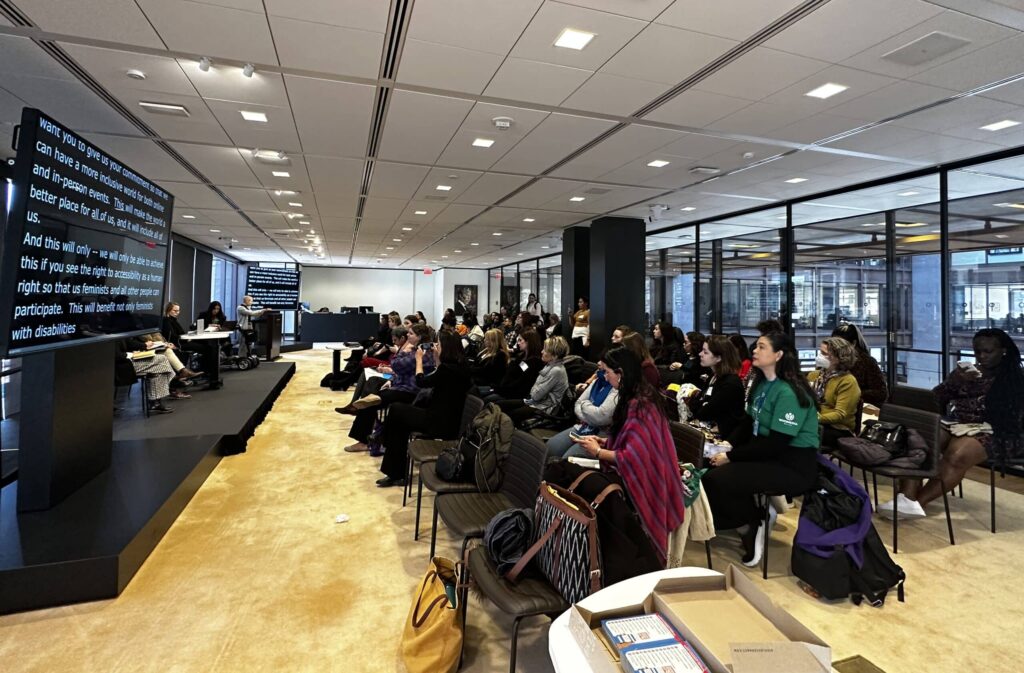
CSW event audience and stage.
Photograph of a side view of the audience, stage, and CART screen at WEI’s CSW67 flagship event.

The event introduced the groundbreaking set of commitments in the Feminist Accessibility Protocol [LINK] and highlighted good practices in utilizing technology and innovating to ensure an accessible, inclusive, valuable, and safe space for feminists with disabilities. In-person accessibility features included English CART for panelists on personal devices and projected for the audience, simultaneous English-Spanish translation for Spanish-speaking panelists, consecutive English-Spanish interpretation for audience members, and American Sign Language in-person interpretation for the event. 

There has been a strong response to the Feminist Accessibility Protocol so far, including 155 endorsements from organizations of persons with disabilities working at the intersection of gender and disability and key feminist stakeholders, such as Women Deliver, CREA, AWID, Liliane Foundation (the Netherlands), Womankind Worldwide, PRBB Foundation, Center for Reproductive Rights, Women Engage for a Common Future (WECF), and Alliance for Feminist Movements. 

Other events where WEI team members presented included:  

  • Advancing Feminist Movements and Leadership: Bringing Generation Equality to the Local Level, organized by United Cities and Local Governments 
  • Gender Equality, Disability and the Digital World, organized by Women with Disabilities Australia 
  • Women with Disabilities, Access to Technology and Equality, organized by Shanta Memorial Rehabilitation Centre 
  • Women with Disabilities Crossing the Digital Divide, organized by the International Convocation of Unitarian Universalist Women 
  • Feminists say “Enough!” Countering Anti-gender Forces and Fostering Collective Resilience, organized by CREA 

Ongoing Work

Inclusive Generation Equality Logo

Further, WEI and the Inclusive Generation Equality Collective launched two ongoing social media campaigns: 

#CommitToAccess – encourages prominent feminists to commit to ensuring the accessibility and inclusion of feminists with disabilities in feminist spaces by signing the Feminist Accessibility Protocol!  

#AccessInPractice – asks CSW attendees to share their accessibility experiences, highlighting good practices and identifying barriers, with the aim of seeing the Feminist Accessibility Protocol in action. 

Please join these campaigns and promote the Protocol!