Cookies are used throughout the Web. Eu legislation (GDPR) protects your right to manage what browsing information is stored and retrieved via cookies. Privacy is your right, and we respect that. We recommend the following cookies for a better experience. You are free to block them at your preference. Contact us for questions or concerns: Info@womenenabled.org
Guidelines for Providing Rights-Based and Gender-Responsive Services to Address Gender-Based Violence and Sexual and Reproductive Health and Rights
Women and Young Persons with Disabilities: Guidelines for Providing Rights-Based and Gender-Responsive Services to Address Gender-Based Violence and Sexual and Reproductive Health and Rights aims to provide practical and concrete guidelines for making GBV and SRHR services more inclusive of and accessible to women and young persons with disabilities and for targeting interventions to meet their disability-specific needs.
The Guidelines were created by Women Enabled International and the United Nations Population Fund and were funded by the Government of Spain. The publication officially launched on Wednesday, November 28, 2018.
Direct links to view the PDF version of the Guidelines in your browser and download to your computer:
Understanding the situation on the ground—and the needs and priorities of our community—is essential to effecting change. This is why field research is an important tool for human rights advocates. But the pandemic upended the traditional ways in which we conduct this work.
WEI’s Pacific Project —which began pre-pandemic— includes extensive research into the issues impacting women and young people with disabilities in several Pacific Island Countries. Our partnerships in the region became even more essential when COVID-19 struck and travel to and within the region was no longer possible. Implementing field research meant close collaboration with trusted colleagues on the ground.
Now, after two years of interviews, focus group discussions, and stakeholder meetings, the results of this work are being launched and disseminated to advocates, allies, policy makers, and service providers, both in the region and to the WEI community globally.
One such groundbreaking resource documents the particular barriers that women and young people with disabilities face in Samoa (including during the pandemic). This report was developed by WEI in close consultation with our regional partner, the Pacific Disability Forum (PDF), a Samoan disabled persons organization, Nuanua O Le Alofa (NOLA), and the United Nations Population Fund (UNFPA)’s Pacific Sub-regional Office (UNFPA-PSRO).
Amongtheissuesprioritizedbywomen and youngpeoplewithdisabilities in Samoa in interviewswere:
stigma and discrimination,
limitedaccesstojustice,
no accesstofamilylifeeducation,
multiplebarrierstoaccessibility, includingphysical, and communicationsbarrierstoexercising sexual and reproductive rights and their right to be free of violence.
Women, girls and gender non-conforming persons with disabilities: Know Your Rights!
A key finding from this research is that women and young people with disabilities need access to easily digestible information about their rights—including rights during the COVID-19 pandemic. So alongside of the country-specific reports, WEI developed a Know Your Rights guide in partnership with PDF and UNFPA-PSRO and with the support of the Australian Department of Foreign Affairs and Trade.
24 October marks the 76 anniversary of the United Nations (UN), in commemoration of the day its Charter entered into force. To celebrate this anniversary and in the spirit of amplifying the voices and the amazing work of women with disabilities, here are three women with disabilities who work within the UN system and help us move towards a more inclusive future, following the well-known “Nothing about us without us.”
María Soledad Cisternas Reyes
A picture of Maria Soledad Cisternas speaking before the UN. Photo courtesy of UCLGCongress
María Soledad Cisternas Reyes has been the UN Secretary-General’s Special Envoy on Disability and Accessibility since 2017. A native of Chile, María Soledad is a lawyer, Law professor and researcher. She is the director of various legal and interdisciplinary projects, author of several publications and speaker at national and international conferences. In her role as Special Envoy, her mandate is to promote the rights of persons with disabilities, with a focus on accessibility for all.
“There is an outstanding debt with women and girls with disabilities in with regard to the exercise of their rights, and this is widely recognized, including in the monitoring work done by the Committee”.
Catalina Devandas Aguilar shaking the hand of the UN Secretary-General, Antonio Guterres. Photo courtesy of OHCHR.
Catalina Devandas Aguilar is a lawyer and human rights defender. Originally from Costa Rica, she was the first Special Rapporteur on the Rights of Persons with Disabilities, a mandate she assumed in 2014 and continued until 2020. In her work as Rapporteur, she focused on the socioeconomic inclusion and the promotion of the full citizenship of persons with disabilities. During her mandate, she emphasized the idea that disability is part of diversity. Catalina is currently Costa Rica’s Ambassador to the United Nations.
“It’s about us valuing difference positively. About us not trying to correct it, not trying to hide it, not trying to cure it. It’s about us saying that it is absolutely normal.”
Catalina Devandas Aguilar — Interview with Noticias ONU
You can find more information about Catalina Devandas Aguilar here.
3. Ana Peláez Narváez
Picture of Ana Pelaez Narvaez. Courtesy: Spanish Embassy in Peru.
A native of Spain, , Ana Peláez Narváez is the Vice-Chair of the Committee on the Elimination of Discrimination against Women (CEDAW), of which she has been a member since 2019. She is the first woman with a disability to serve on this treaty body.
Since joining the Committee, Ana has sought to ensure the application of an intersectional approach to the work of the Committee to account for the multiple discriminations experienced by women, including women with disabilities. She has also served as a member and vice-chair of the UN Committee on the Rights of Persons with Disabilities.
“The first and foremost challenge is that women with disabilities are not recognized as women.”
María Soledad Cisternas Reyes, Catalina Devandas Aguilar and Ana Peláez Narváez in their different roles within the UN system show how women with disabilities can exercise leadership in pursuit of inclusion in international cooperation. On this UN Day, we celebrate them and thank them for their relentless work to advance the rights of people with disabilities worldwide.
Pride months are about honoring the intentionally silenced stories from our past, reaching out to check in and celebrate with our communities, and digging deeper into our activism and organizing for a better future — one where we can all be proud.
A rainbow flag lit by the sun waves in the wind against a backdrop of trees. Photo by Brittany J. Evans.
As someone holding the legacies of many identities — Queerness and disability included — , Pride months can feel both like warranted, inspiring declarations of progress and like hollow gestures from our corporate overlords meant to quell our hunger for equality. (I mean, we got a whole month for each, right?).
“Both/and” is my hymn, and while I do recognize the existence of those empty gestures and marketing ploys, I think it’s important to explore Pride, what it takes for our communities to feel proud, and the role these months can play in helping us rebuild a world that is more diverse, more just, and more inclusive of us all. Here are five ways you can honor Queer and Disability Pride:
1. Diversify Your Feed
Three people sit on the ground smiling and looking at a cellphone. Photo by Priscilla Du Preez via Unsplash
Make it a practice to include a plurality of voices in the content you consume. Follow a diversity of creators, organizations, models, even meme accounts year-round — not just during their government-given month of pride. Our communities are growing and flourishing on social media. They’ll brighten up your feed!
It’s during Pride when I listen the hardest for the echoes and lessons of our disabled and queer ancestors by intentionally seeking the parts of our past that were excluded from history books. Podcasts, documentaries, and, honestly, social media are all places where I’ve learned more about historical queer and disabled figures than in any classroom.
A small rainbow flag is raised above a crowd in the sunlight. Photo by Brian Kyed via Unsplash.
Learning about the history of the movements puts my life and work into context, connects me to a story spanning volumes beyond my pages, and makes me feel less alone.
Tan France’s Queer Icons podcast on Audible. You’ll hear a familiar name. I was interviewed for the second episode covering the life and legacy of trans disabled activist, Bobbie Lea Bennett!
3. Make Space for Uncomfortable, Ongoing Reflection and Unlearning
We are tender beings with fragile egos wrapped in layers of indoctrination. In many cultures, disability and queerness have been synonymous with shame for centuries. Even still, identifying as disabled or queer can be life-threatening. We can’t expect to renounce that inheritance and unwrap liberation overnight. Unlearning is messy, painful, and transformative. Yet, we must make space for discomfort in ourselves and in our communities.
Overhead view of three people studying at a table. Photo by Alexis Brown via Unsplash
Join a book club, talk to your friends, ask deep questions on first dates, share reflection questions, resources, and opportunities with your circle. You will make mistakes. We all do. Share your stories of learning. Leave the door open for others to share theirs. Bask in the discomfort together.
Ask yourself hard questions about gender, disability, and sexuality. What does it mean to be disabled? To be queer? Make reflection a practice. An examined life is a continual process of becoming.
Here are a few of my favorite resources for guided reflection to get started:
This Pride, I want to intentionally celebrate and honor the act of living. Especially after the past year with COVID-19, I’m using these two months not to dance in the street with rainbow flags leaving glitter on everything I touch, but to check in with those in my community that I may not have had the capacity to talk to over the past year while we were all so focused on merely surviving.
Even through trending hashtags, mentionable news coverage, ticker-tape parades, educational campaigns, and corporate pandering, Pride provides an opportunity to check in with the broader community and hear from voices outside of our immediate echo chamber.
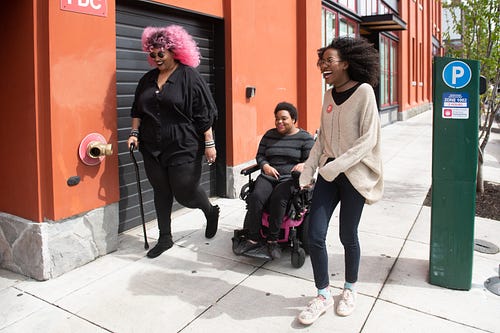
Three people laughing and going down a sidewalk. Photo by Chona Kasinger via Disabled and Here
What are the main issues that surfaced this Pride? Who are the current figures leading the movement? Are there local organizations working on these issues? What resources are available to you and your community? What are the ways in which you support each other?
There are already people and organizations out there doing the work. Search online for local mutual aid networks, collectives, and organizations. If you are in the United States, one way is to use Mutual Aid Hub to find community-supported efforts near you.
5. Meet at the Intersections
A group of people walking through a rainbow crosswalk. Photo by Greg Rosenke via Unsplash
Pride is a reminder that you are not in this struggle alone. Meet and work alongside allies at shared intersections. Collaborate, share stories, unlearn together and build community across movements by acknowledging and honoring the both/and of existence.